

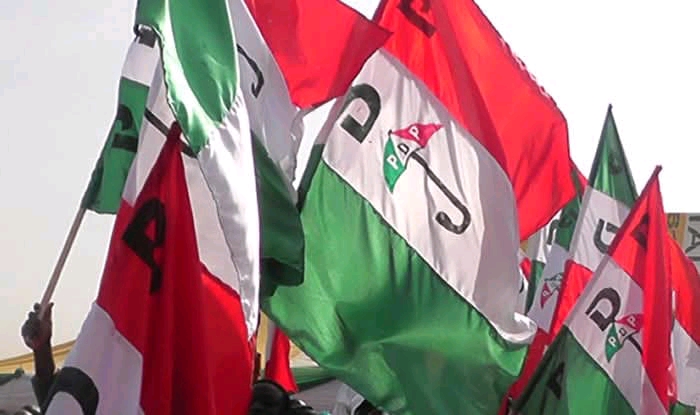
There’s a certain way people talk about the People’s Democratic Party these days.
As if its story is already over. As if the crises have finally caught up with it.
It sounds convincing, until you take a longer view.
Because if there’s one thing that defines the PDP since 1999, it is not stability. It is survival. The party has stumbled through one storm after another, some of them self-inflicted, some of them structural, and a few that nearly tore it apart.
Yet, here it is, still woven into the fabric of Nigeria’s politics, still impossible to ignore.
To understand why writing it off ahead of 2027 may be premature, you have to walk through those crises carefully. Not as a single narrative, but as a series of moments, each shaped by its own pressures and peculiarities.
When the PDP came into power in 1999 under Olusegun Obasanjo, it wasn’t a tightly organized party in the classic sense. It was a broad alliance.
Former military figures stood alongside career politicians. Regional power brokers shared space with technocrats and grassroots mobilisers.
That breadth gave the party reach across the country. It also meant that internal conflict was almost inevitable.
In several states, elected governors found themselves locked in battles with political godfathers who believed electoral victory entitled them to control.
At the national level, the presidency often dominated party structures, leaving internal processes weak and easily overridden.
Still, those conflicts had limits. They were sharp, sometimes messy, but rarely existential. The party controlled the federal government, and that single fact kept everyone, however reluctantly, within the same tent.
Power, in those years, was the ultimate mediator.
The transition period between Umaru Musa Yar’Adua and Goodluck Jonathan changed the tone of the conversation.
President Yar’Adua’s illness and eventual passing created more than a leadership vacuum. It exposed the delicate balance the PDP had quietly relied on, especially the informal zoning arrangement between the North and South.
Jonathan’s rise disrupted that balance, and suddenly, the argument inside the party was no longer just about who held power. It was about whether the party could be trusted to keep its own word.
For the first time, the PDP was dealing with something deeper than ambition. It was dealing with questions of fairness, trust, and internal legitimacy.
It survived, largely through compromise. But something had shifted beneath the surface.
By the time the 2011–2015 period unfolded, those underlying tensions had hardened.
What followed was not just another internal disagreement. It was a coordinated rupture.
A group of influential governors and party heavyweights broke away to form what became known as the New PDP. Meetings turned confrontational.
Walkouts became public spectacles. Grievances that might once have been negotiated quietly were now aired openly.
Key figures moved into the emerging opposition coalition, fundamentally altering the political equation.
The public distancing of Olusegun Obasanjo was not just personal. It clearly indicated that the old elite consensus holding the party together had collapsed.
The outcome is now part of Nigeria’s political history. In 2015, the PDP lost the presidency.
But what is often time overlooked is what did not actually happen and that is the fact that the party did not disappear in the face its multifaceted crises.
Losing federal power in 2015 for the first time since 1999 actually stripped away the glue that had held the PDP together for years. What followed was perhaps its most chaotic period.
The leadership tussle between Ali Modu Sheriff and Ahmed Makarfi pushed the party into unfamiliar territory. There were parallel claims to leadership. Competing conventions. Confusion over who truly spoke for the party.
For a moment, it felt as though the PDP might split into irreconcilable parts.
The resolution did not come from internal negotiation. It came from the Supreme Court, which affirmed the Makarfi-led structure and restored a measure of order.
It was a reminder that if one was needed, that the party had reached the edge of institutional breakdown.
After that crisis, the PDP steadied itself. It reorganised, reconnected with its base, and began to regain ground, especially at the state level.
But there was a silent problem lingering beneath the surface. And that birthed the question what exactly did the party stand for now?
Without the leverage of federal power, and with many of its internal contradictions exposed, the PDP struggled to articulate a clear direction.
Defections continued, alliances shifted, and personalities often overshadowed policy.
It was not a dramatic crisis. There were no headline-grabbing splits. But it was a slow drift, a kind of uncertainty about identity.
The crisis leading into the 2023 elections felt different from what had come before.
In earlier moments of PDP challenges, dissatisfied factions left the party but this time, they stayed.
The dispute over zoning of the presidential ticket triggered open resistance from a group of influential governors codenamed the G-5, with Nyesom Wike emerging as a central figure.
They did not defect. They did not form a parallel structure. Instead, they remained within the PDP while openly opposing its presidential candidate.
It created an unusual situation. A party contesting a national election without full internal alignment.
Campaign messaging suffered, coordination weakened, and the cracks became very visible to everyone.
This was not rebellion from outside at this point like playing opposition in a new party, it was resistance from within its own fold.
Looking at the PDP today, one would realize that, the present moment is, in some ways, the most complex the PDP has faced since the return of democratic governance in 1999.
There is no single crisis to point to. Instead, there are layers of tension. Disagreements over leadership within the National Working Committee.
Renewed debates about zoning ahead of 2027, lingering mistrust among key figures, and court cases becoming part of internal conflict resolution.
Power is no longer concentrated in one place. It is spread across different political blocs, each with its own influence, each with its own calculations.
That in itself makes the party look unstable. And in some respects, it actually is. But it is also still functioning, depicting what’s usually called ‘a cat with nine lives’.
The party, against all odds has shown that it is still negotiating, still present, and it has not frozen out of political business as being projected. It has not fractured beyond repair.
Of course, It is easy, in moments like this, to conclude that the party has run its full course. That the weight of its internal contradictions is finally too much to bear but that reading misses a few important or rather puts key realities.
The PDP remains one of the most deeply rooted political structures in Nigeria. Its presence is not superficial. It stretches across states, local governments, and communities, built over decades.
It also has a certain elasticity. Politicians do leave and return afterwards. Alliances shift, then shift again. What looks like instability can also be a form of adaptation.
And perhaps most importantly, Nigerian politics has never rewarded perfection. It rewards viability and structures that can compete, mobilise, and endure.
By that measure, the PDP is clearly showing the world that it is still very much in the game.
None of this erases the challenges before the party, though. Trust has to be rebuilt. Leadership questions have to be resolved. Strategy has to become clearer.
But history offers a useful caution because there have been moments before when the PDP was declared finished, particularly after the defections that led to 2015 defeat to the ruling All Progressives Congress (APC).
During the leadership crisis that followed. Even after internal divisions threatened to overwhelm it.
Each time, it found a way to reassemble itself.
However, that does not guarantee what happens in 2027. Politics rarely offers guarantees.
But it does suggest that writing the party off entirely may say more about impatience than about political reality.
Because if the PDP has shown anything over the years, it is that the party does not move in straight lines, it bends, it fragments, regroups, and somehow, it endures and bounces back as a unit.
Henry Odeh, is a Public Affairs Analyst. He writes from Ibadan.
E-mail: henry007mike@gmail.com