

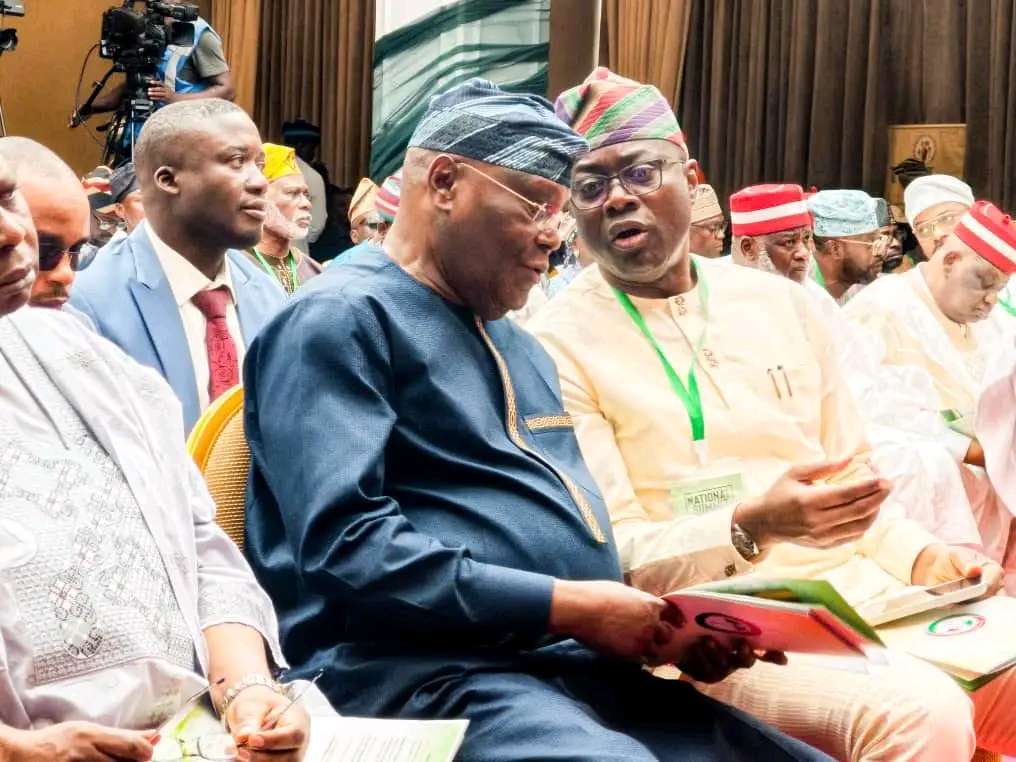
There was a quiet intensity in Ibadan over the weekend. Not the kind that comes with noise or confrontation, but the kind that settles in a room when people know they are dealing with something bigger than themselves.
The gathering at the Government House Banquet Hall was, on paper, a political summit. In reality, it felt like a moment of reckoning.
Across party lines, opposition leaders came together and, perhaps for the first time in a long while, spoke in one voice.
This can be best described as similar to the 2013 political amalgamation where the defunct Action Congress of Nigeria (ACN), Congress for Progressive Change (CPC), All Nigeria Peoples Party (ANPP), and a faction of the All Progressives Grand Alliance (APGA) all came together to form the All Progressives Congress (APC) with the primary agenda being to unanimously field a single presidential candidate to challenge the then president, Goodluck Jonathan of the People’s Democratic Party (PDP).
Message of the opposition leaders in Ibadan was not complicated. They believe Nigeria’s democracy is under pressure and they believe the only way to respond is to stand together and united.
That belief has produced the most striking outcome of the meeting. A shared decision to work toward presenting a single presidential candidate in 2027 to challenge Bola Ahmed Tinubu and the ruling All Progressives Congress.
This strategic move looks more like an attempt to serve president Tinubu back in his own coin.
It is the kind of decision that signals both strategy and concern.
Strategy, because a fragmented opposition has historically struggled to compete effectively. Concern, because such unity rarely emerges unless there is a strong feeling that the political field is already tilting in one direction.
Seyi Makinde’s words at the event were measured, but they carried a hidden urgency.
He spoke about a slow drift, about how democracy does not disappear overnight but weakens gradually when competition fades and power concentrates.
“Democracy without opposition is not democracy, it is a slow drift toward a one-party state,” Makinde said.
That line stayed with many in the room and it gave deeper meaning to his earlier reference to “Operation Wetie.”
That phrase itself carries a history that is impossible to ignore.
In 1965, following a deeply disputed Western Region election, political violence erupted across parts of the region, with Ibadan as one of its epicentres.
Supporters of rival factions clashed openly. Homes and properties were destroyed.
The term “wetie,” drawn from Yoruba expression, described the brutal act of dousing opponents with petrol and setting them ablaze.
It was not metaphorical. It was real, immediate, and devastating.
That breakdown followed years of political rivalry between figures like Obafemi Awolowo and Samuel Ladoke Akintola, and it exposed how quickly electoral disputes could spiral when institutions lose credibility.
Within months, the crisis contributed to the collapse of the First Republic and Nigeria’s first military coup in January 1966.
So when a modern political leader invokes “Operation Wetie,” even in passing, it does not land lightly. It reopens a chapter many would rather study than relive.
Makinde did not repeat the phrase at the summit. But it lingered. It shaped how his message was heard.
Because once you invoke a moment like that in Nigeria’s history, you are not just speaking about the past. You are pointing to what can happen when political systems lose balance.
For some, his remark was clearly a warning and a reminder that when people lose faith in elections and institutions, the consequences can spiral beyond control.
For others, it felt uncomfortably close to a scary memory, one that should be handled with more caution in an already tense environment.
But to understand why the remark landed the way it did, you have to look at the mood in the room.
Leaders who have often stood far apart found themselves aligned. Atiku Abubakar, Peter Obi, Rabiu Musa Kwankwaso, Rotimi Amaechi, and others spoke with a shared sense of urgency.
Tanimu Turaki captured it in simple terms. Unity, he said, is no longer optional. Disunity has weakened the opposition before, and repeating that mistake could be costly.
It was a practical argument, but also an emotional one. The idea that Nigeria is experiencing what he described as “progressive regression” came up more than once.
Not just in politics, but in security, in the economy, in public trust.
David Mark took it a step further, calling the moment a “national rescue mission.”
His words carried the weight of someone who has seen the system from the inside for decades.
He spoke about the need to move beyond fragmentation, to build something more coordinated, more deliberate.
“We cannot confront the future as fragmented entities,” he said.
That sense of urgency flowed into the Ibadan Declaration and the communiqué that came out of the summit.
The communiqué was firm in tone. It rejected any drift toward a one-party system. It insisted that Nigerians must be given real choices in 2027.
It also raised serious concerns about the electoral process itself, questioning the neutrality of the Independent National Electoral Commission and calling for reforms to the Electoral Act before the 2027 elections.
These are not small issues. They go to the heart of whether elections will be trusted when they come.
And that is where the deeper tension now lies because Nigeria has walked this road before and it understands the pattern of political events.
There was a time when elections lost credibility so completely that people stopped believing in them.
When that happened, politics moved off the ballot and onto the streets. That period left scars that still shape how older generations think about power and conflict.
There was also another moment, decades later, when language itself became part of the tension.
In 2012, ahead of another electoral cycle, a statement attributed to Muhammadu Buhari warned that if elections were rigged, “the monkey and the baboon would be soaked in blood.”
Like “Operation Wetie,” it drew from local idiom, but it quickly entered national discourse.
Supporters argued it was a warning against electoral malpractice. Critics saw it as dangerously suggestive.
That moment reflected how deeply mistrust of the electoral system had grown at the time.
It also showed how political language, once released, can take on meanings far beyond what was intended.
Years later, in 2015, the country faced another moment of high tension. The rhetoric was sharp. The stakes were enormous. But something held.
Institutions, though tested, managed to carry the weight. And when the results came, there was a level of restraint that surprised many.
That memory still offers a kind of hope and proof that even in tense moments, the system can hold if enough people choose to let it.
The question now is, which direction things are moving? Because what came out of Ibadan was not just a political strategy. It was also a signal.
A signal that opposition leaders feel squeezed already. That they are preparing for a contest they believe may not be entirely level.
Speakers like Pat Utomi and Kabiru Adamu widened the conversation beyond politics.
They spoke about economic hardship, insecurity, and the growing disconnect between leaders and citizens.
These are the conditions that often make political tensions harder to manage. When people are struggling, their patience with perceived injustice tends to wear thin.
That is why language matters so much in moments like this.
Makinde’s “Operation Wetie” remark sits right in that space. It is heavy with meaning. It can be read as a reminder of what must be avoided. It can also be heard as a phrase that risks stirring emotions best left settled.
But perhaps the more important question is not what he meant, or even how it was received. It is what happens next.
If the concerns raised in Ibadan lead to real efforts to strengthen electoral credibility, open up political space, and rebuild trust in institutions, then his words will likely be remembered as a necessary caution.
If those concerns are ignored, if the political environment becomes even tighter, then the same words may take on a different tone in hindsight.
Ibadan itself adds another layer to all of this. This is a city that has seen both the promise and the peril of Nigerian politics.
It has hosted conversations that helped shape the country. It has also witnessed moments when that shape seemed to fracture.
Now, once again, it finds itself at the centre of a national conversation and in that conversation, one thing is clear.
Nigeria is not yet at a breaking point but it is at a point where choices matter more than usual.
The decision by opposition leaders to unite, the warnings about democratic erosion, the concerns about electoral integrity, and even the weight of a single historical phrase all point in the same direction.
And that is a reminder to the fact that democracy is not something that sustains itself anywhere in the world,
it must be protected by political actors and the people alike.
Protected carefully, deliberately, intentionally even against personal convenience, and sometimes, urgently.