

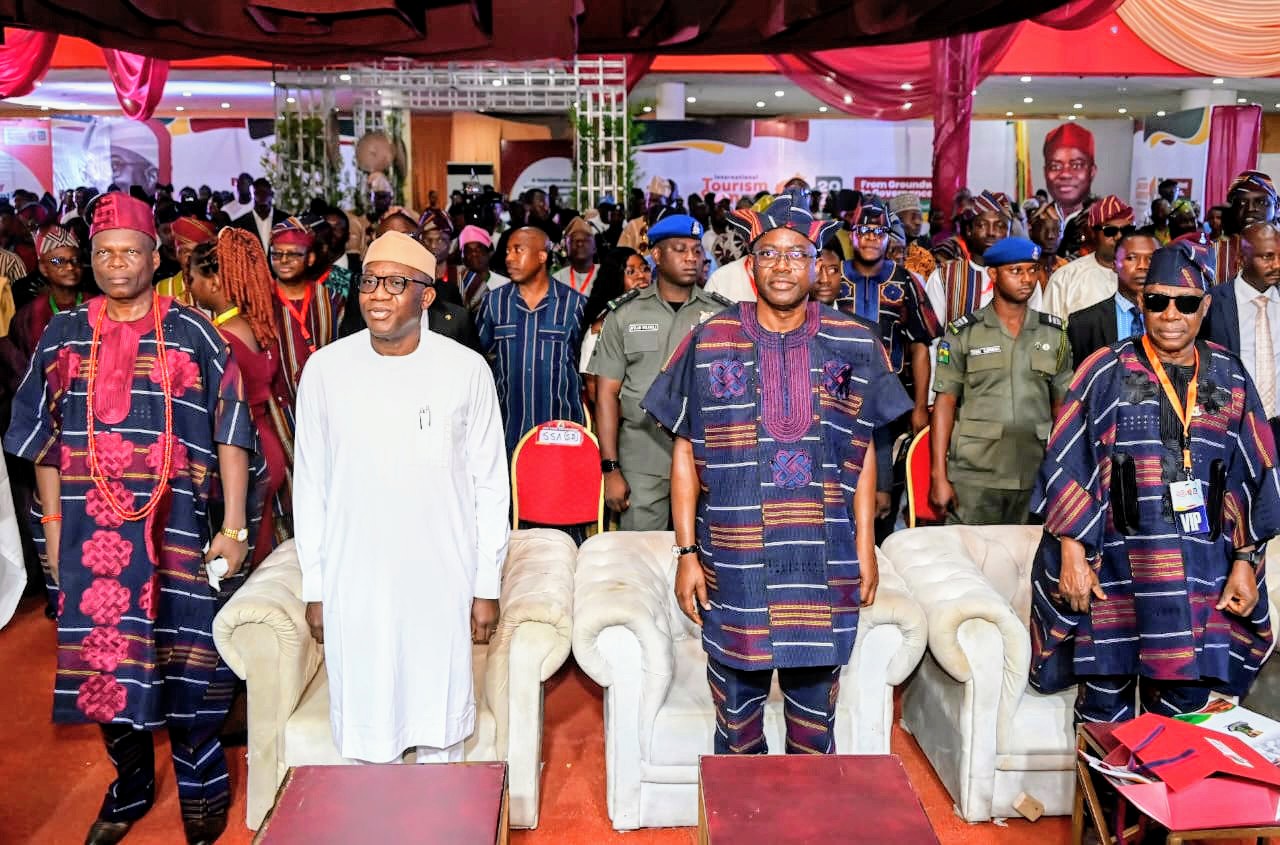
Governor Seyi Makinde has declared that political intimidation and the use of federal influence would not determine the outcome of the 2027 elections in Oyo State, insisting that the people are prepared to defend their democratic choices at the polls.
The governor made the remarks on Wednesday during his address at the 2026 Oyo State International Tourism Summit held at the International Conference Centre, University of Ibadan.
Makinde, while speaking before investors, tourism stakeholders, government officials and political associates, combined his administration’s development agenda with ongoing political buildup ahead of the next electoral cycle.
He maintained that the future of Oyo State must be anchored on continuity, competence and popular participation.
Speaking on the 2027 political contest, Makinde expressed confidence that Nigerians are becoming more politically conscious and would resist any attempt to impose leaders through federal influence or intimidation.
“It may have happened in Ekiti State and other instances in the past but this time around, it is Nigerians that are ready to show politicians pepper,” the governor declared.
“They will show us that they are no more bystanders, they will participate and I’m sure of what I’m saying.”
Makinde maintained that while leadership may change, enduring systems and institutions are what guarantee sustainable development.
He urged voters to pay close attention to competence and leadership capacity ahead of the next election cycle, warning that poor electoral choices carry long-term consequences.
“I tell people that I can only recommend for Oyo State people but the decision rests with them,” he said.
“If they make the mistake of electing someone who will not deliver due to defective capacity, election is a one-day event but the impact will last four whole years, so we must get it right.”
In what some at the event interpreted as a subtle warning to political actors within and outside his camp, the governor cautioned against acts capable of undermining his administration before the expiration of his tenure.
Makinde reminded political stakeholders that he remains constitutionally in charge of the state until May 29, 2027, indicating that his administration would not tolerate internal sabotage or distractions as succession politics intensify across the state.
The governor also used the occasion to defend his style of political mentorship and appointments, while dismissing criticisms surrounding the emergence of individuals perceived by some critics as having ties with the opposition All Progressives Congress.
According to him, competence and loyalty to Oyo State remain the major considerations for his administration rather than political affiliation.
“Some people said, ‘Oh Seyi, you couldn’t mentor anybody without a taint of APC inclination in seven years of being in government to succeed you,’ and I asked, is Bimbo Adekanmbi or Morounkola Thomas from Oyo State or not?” the governor said.
“They agreed they are from Oyo State and I said okay, well for us, if you’re from Oyo State and loyal to Oyo State, and you have the capacity, we will tap you to support the development of Oyo State.”
Makinde further stressed that his administration deliberately accommodates capable individuals across political divides in order to sustain governance and development.
“For every Morounkola Thomas, there’s a Segun Ogunwuyi, for every Bimbo Adekanmbi, there’s Professor Musibaudeen Babatunde. We’re blind to party coloration, we’re open to capacity that can move Oyo State forward,” he added.
The governor also reiterated his vision of transforming Oyo into the tourism capital of South-West Nigeria, citing massive infrastructural development across the state, especially within the Oke-Ogun axis.
He recalled that members of the summit had recently toured parts of the zone, expressing confidence that the region would soon become a major tourism and investment destination.
Makinde boasted about the quality of roads constructed under his administration, noting that commuters can now travel long distances across the state without encountering potholes.
“I used to boast to people that from the train station at Moniya, you can drive on state roads at least 180 kilometres with no single pothole,” he said.
“You can drive Moniya to Iseyin, from Iseyin to Ogbomoso, and from Iseyin to Oyo without finding a single pothole.”
The governor, however, shifted focus to what he described as the deeper concern of investors, noting that many private sector players are worried about policy continuity after the expiration of tenure.
According to him, investors are often more concerned about whether agreements signed by one administration would be respected by another.
“When investors consider opportunities within our environment, there’s always an underlying question,” he said.
“The question is, what happens after this administration? Will policies continue? Will agreements be honoured? Will priorities remain consistent? These are valid concerns because investment by its nature is long-term.”
Makinde warned that inconsistent governance and abrupt abandonment of projects by successive administrations have historically discouraged investment and slowed development.
Using the 110-kilometre Circular Road project as an example, the governor lamented that the initiative, conceived in the early 2000s, suffered years of stagnation before eventually becoming reality under his administration.
“Any private player who was hoping on working with that corridor would have been disappointed and investment lost,” he stated.
Also present at the event was the former two term governor of Ekiti state, Dr Kayode Fayemi, Nollywood star actor and movie producer, Kunle Afolayan, and others.