

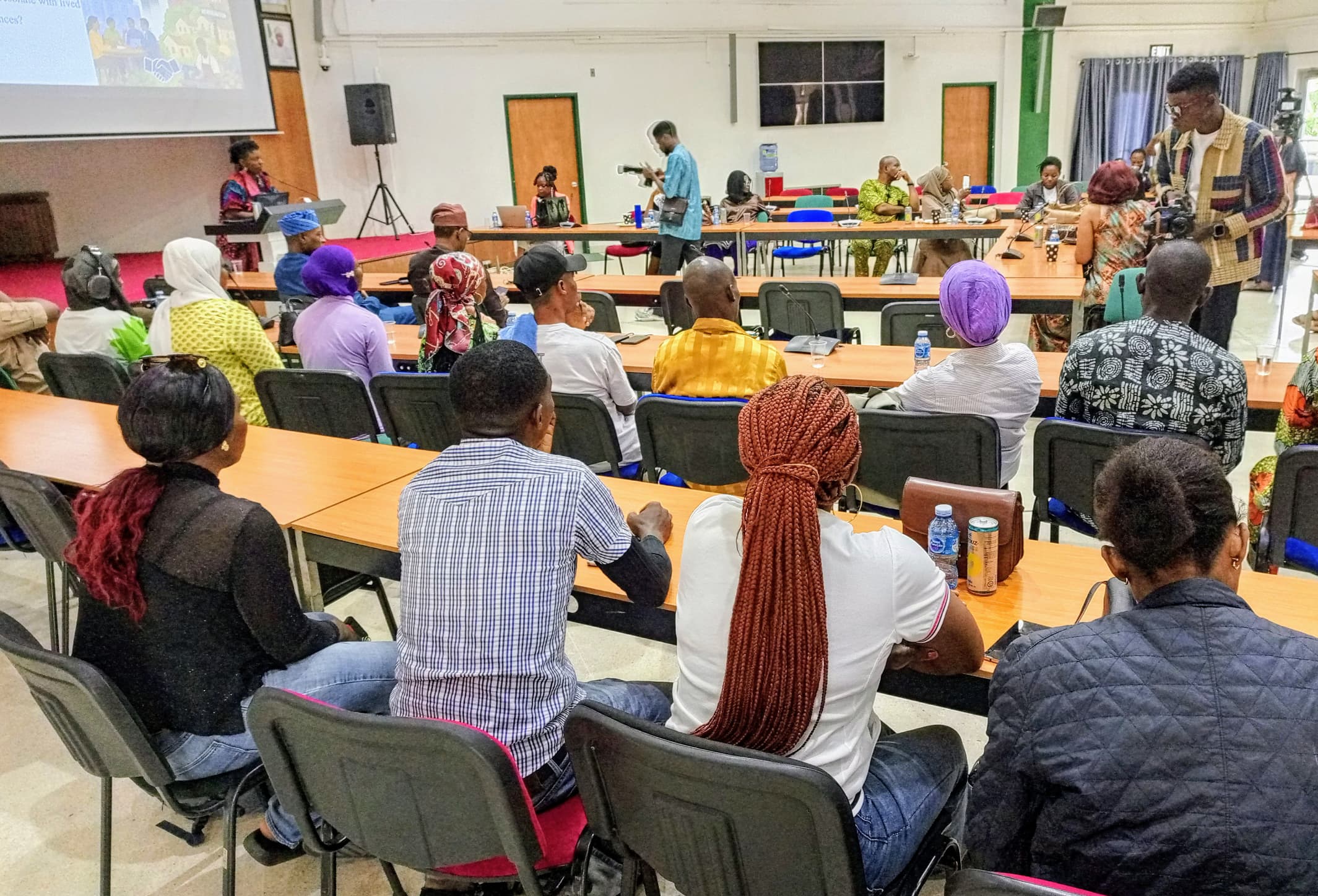
The Oyo State Government has reaffirmed its commitment to strengthening reintegration programmes for return migrants and survivors of human trafficking through evidence-based policies, youth empowerment and strategic partnerships aimed at tackling the root causes of irregular migration.
The assurance was given on Saturday at the Stronger Futures Dialogue, organised by the University of Amsterdam in collaboration with the Oyo State Government at the International Institute of Tropical Agriculture (IITA), Ibadan.
The migrants who comprised of largely young persons from Oyo, Osun, Ondo, Lagos and other parts of south west states were undergoing different stages of rehabilitation in preparation for their capacity building and empowerment.
Delivering the keynote address on behalf of Governor Seyi Makinde, the Special Adviser on Migration and Homeland Security and retired Assistant Comptroller General of Immigration, Barrister Segun Adegoke, said the administration remains committed to building a migration governance system that restores dignity, creates opportunities and promotes sustainable development.
He described the dialogue, themed “From Evidence to Action: Strengthening Reintegration for Return Migrants and Survivors of Human Trafficking in Oyo State,” as a timely intervention that reflects the significance and importance of translating research into practical government policies capable of changing lives.
Adegoke lauded the University of Amsterdam, particularly the convener of the Stronger Futures Project, Dr. Sarah Adeyinka, for championing research that amplifies the voices of people with lived migration experiences while supporting evidence-based policymaking.
Drawing from his over three decades of service in the Nigeria Immigration Service, he stressed that migration governance should extend beyond border security to restoring hope, dignity and opportunities for returnees, particularly survivors of human trafficking and migrant smuggling.
He said the conviction informed Governor Makinde’s decision to establish the Office of Migration and Homeland Security in 2022, with a mandate to integrate migration governance into youth development, economic empowerment and social inclusion.
According to him, the state has continued to implement awareness, prevention and reintegration programmes in line with the reviewed National Migration Policy 2025 and the United Nations Global Compact for Safe, Orderly and Regular Migration.
The governor’s representative disclosed that Oyo State is strengthening collaboration with the National Commission for Refugees, Migrants and Internally Displaced Persons (NCFRMI), the International Centre for Migration Policy Development (ICMPD) and other development partners through the Youth Empowerment and Reintegration Project (YERP).
He explained that the initiative targets about 700 rural and returning youths by promoting climate-smart agriculture, skills development, access to land and sustainable livelihoods.
Adegoke noted that the allocation of 10,000 hectares of farmland by the Oyo State Ministry of Agriculture for young farmers is expected to reduce youth unemployment while addressing one of the major drivers of irregular migration.
He argued that reintegration should not be treated merely as post-return assistance but as a strategic investment in resilience, productivity and community development.
According to him, giving returnees access to productive land, modern agricultural skills, finance, markets, mentoring, psychosocial support and economic opportunities would not only rebuild lives but also reduce desperation and protect survivors from falling prey to traffickers again.
He also highlighted the role of the Oyo State Reintegration Committee, which he chairs, describing it as a critical component of Nigeria’s migration governance architecture.
He said the committee brings together relevant government agencies and non-state actors to provide coordinated support for returnees through temporary shelter, socio-economic reintegration, skills acquisition, psychosocial care, empowerment and legal assistance.
Adegoke reaffirmed the state’s commitment to strengthening the committee through sustained institutional support and partnerships, insisting that government institutions, academia, civil society organisations, development partners and the private sector must work together because no single institution can achieve lasting reintegration alone.
He identified the state’s priorities as expanding economic opportunities for young people, tailoring reintegration programmes to the specific needs of returnees, strengthening stakeholder collaboration, promoting research-driven policymaking and reducing the stigma often associated with return migrants.
“The success of reintegration will not be measured by the number of meetings held or reports produced, but by lives rebuilt, young people productively engaged, stronger communities and vulnerable persons protected from exploitation,” he said.
Speaking with journalists after the dialogue, the convener of the programme and researcher at the University of Amsterdam, Dr. Sarah Adeyinka, said the Stronger Futures Project was conceived to help return migrants rebuild their lives and discourage repeat irregular migration.
She explained that the research, funded by the University of Amsterdam, was inspired by the continued high rate of trafficking involving Nigerians in other parts of Africa and Europe.
According to her, Nigerian nationals have consistently ranked among the top nationalities trafficked into the European Union from outside the bloc over the past decade, making it imperative to develop sustainable reintegration models that address the real needs of returnees.
“The idea behind this study is to create a stronger future for return migrants. We want to understand what kind of support they actually need when they return home so they can remain in Nigeria and not be forced to embark on the dangerous journey again,” she said.
Adeyinka stressed that reintegration must go beyond financial assistance, noting that many returnees require psychological and mental health support before economic empowerment can be effective.
“If you provide money for someone who is mentally and psychologically not ready to use it, that support may not achieve the desired result. We need to strengthen mental healthcare, psychosocial services, physical healthcare, accommodation, skills development and employment opportunities,” she explained.
She disclosed that the research team has been working closely with the Oyo State Office of the Special Adviser on Migration and Homeland Security to examine existing reintegration structures and identify ways of connecting return migrants with available government support.
According to her, the collaboration seeks to ensure that returnees are aware of the services available to them and can easily access the assistance they require.
Assessing Oyo State’s performance, Adeyinka commended the government for putting in place several reintegration initiatives, saying the state had exceeded her initial expectations.
“I think Oyo State has done more than I expected. However, there is still a lot to be done because many people simply do not know the services the government already provides.
“The challenge now is making those interventions more visible and accessible to those who need them most,” she said.
She also advocated broader awareness campaigns targeting parents, guardians and religious leaders, describing them as critical stakeholders in preventing human trafficking.
The researcher revealed that one of her forthcoming studies would focus on the role of families in migration decisions, following earlier findings that showed family members could either knowingly or unknowingly facilitate trafficking.
“Some parents are deceived, while others unknowingly encourage dangerous migration. In previous studies, some survivors even said their pastors or religious leaders encouraged them to embark on the journey.
“That tells us advocacy must go beyond potential migrants to include families, guardians and faith leaders.
“At the same time, where individuals deliberately facilitate trafficking, the law must take its course. Awareness is important, but accountability is equally necessary,” she added.
Also, Mr Kayode Alfred, the Commandant, National Agency for the Prohibition of Trafficking in Persons (NAPTIP), Oyo State Command, highlighted the dangers desperation to acquire wealth by young Nigerians.
While acknowledging the socioeconomic challenges in the country, he noted that such challenges are not peculiar to Nigeria and should not culminate into such level of desperation that is capable of putting human lives in danger.
He highlighted activities of NAPTIP and what it is doing in collaboration with Oyo state government and other partners to curb and put an end to human trafficking of any form, warning that anybody caught involved in such criminal act will be brought to book.
“In the area of victim protection, we work closely with the Ministry of Women Affairs, particularly on sheltering and rehabilitating rescued victims. We also collaborate with the Ministry of Justice under the leadership of the Attorney General and Commissioner for Justice to ensure that human trafficking cases are effectively handled.
“NAPTIP also established the Oyo State Task Force on Human Trafficking in 2020. The task force is chaired by the Honourable Commissioner for Justice and Attorney General, while the NAPTIP State Commander serves as the co-chairman.
“Its membership comprises representatives of civil society organisations, non-governmental organisations, security agencies such as the Nigeria Police Force, Department of State Services (DSS), Nigeria Security and Civil Defence Corps (NSCDC), Nigeria Immigration Service and other relevant stakeholders involved in combating human trafficking.
“The task force meets regularly to address trafficking issues. We collaborate on case referrals, capacity-building programmes, workshops, intelligence sharing and joint operations aimed at arresting traffickers and rescuing victims.
“Overall, the Oyo State Government has demonstrated strong commitment to combating human trafficking through its collaboration with NAPTIP.
Some of the returnees who spoke to newsmen on condition of anonymity narrated their ordeals described as horrific. They appealed to government, stakeholders, and other relevant bodies to help them with necessary support for reintegration and resettlement for their lives to regain meaning and purpose.
The dialogue brought together government officials, migration experts, academics, development partners, civil society organisations and security agencies to explore practical, evidence-based approaches to strengthening reintegration systems for return migrants and survivors of human trafficking in Oyo State.