

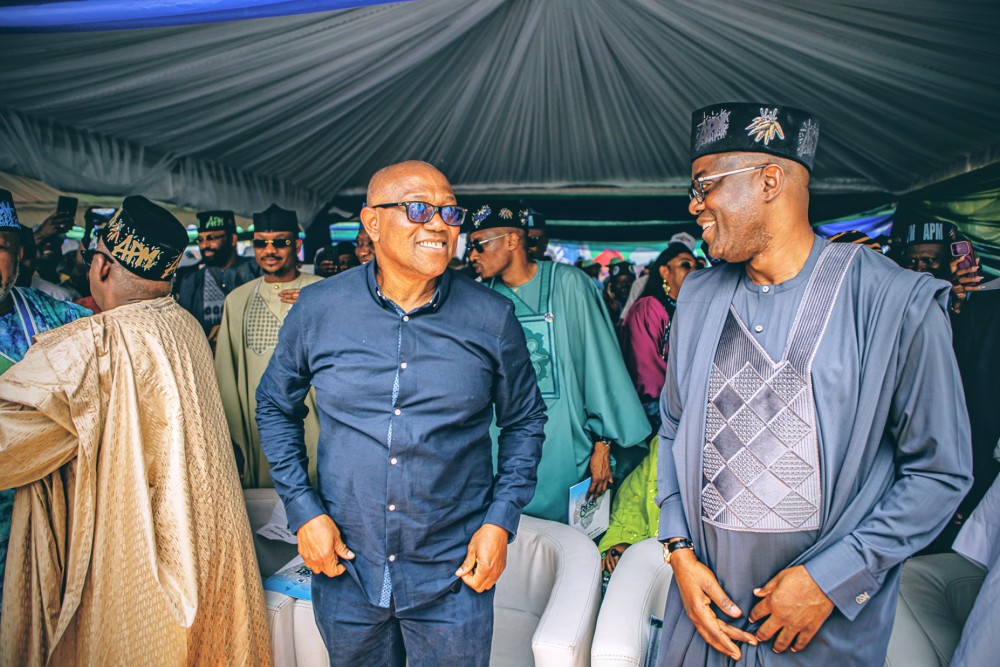
Governor Seyi Makinde of Oyo State has condemned the alleged obstruction of the convoy of the Presidential Candidate of the Nigerian Democratic Congress (NDC), Peter Obi, during his visit to Benue State, describing the incident as evidence of growing desperation by the ruling All Progressives Congress (APC) to silence opposition voices ahead of the 2027 general elections.
Makinde, in a statement issued on Wednesday by his Special Adviser on Media, Dr Suliamon Olanrewaju, described the alleged blockade of Obi’s convoy as “unwarranted,” “deeply disturbing” and “totally unacceptable.”
According to him, the incident occurred on Tuesday, September 8, 2026, while Obi was travelling to Yelwata to visit families affected by the tragic killings recently recorded in the area.
The governor alleged that Obi’s convoy was obstructed by suspected state-sponsored thugs, describing the development as “a new low in the desperation by the ruling APC to stifle opposition leaders ahead of the 2027 general elections.”
Makinde said it was particularly disturbing that the incident occurred barely 24 hours after Obi joined other prominent opposition figures at the inauguration of the Makinde/Daura Presidential Campaign Office in Abuja on Monday, September 7.
He suggested that the political developments within the opposition camp had unsettled the APC, accusing the ruling party of resorting to intimidation and harassment because of what he described as its difficulty in selling President Bola Tinubu’s administration to Nigerians.
“Expectedly, the ruling APC, overburdened by the sad reality of marketing an unpopular President Tinubu to Nigerians, is seriously afraid and completely rattled by the latest political developments,” the statement said.
Makinde argued that the alleged obstruction of Obi’s movement was inconsistent with the principles of constitutional democracy, stressing that Nigerians have fundamental rights to freedom of movement and association.
He cited Sections 41(1) and 40 of the 1999 Constitution, which respectively guarantee freedom of movement and the right to peaceful assembly and association.
The governor also rejected the explanation reportedly given by the Benue State Government that Obi failed to obtain prior permission before visiting the state.
According to him, no Nigerian, regardless of political status, requires permission from a state government to enter or move freely within another state for legitimate activities.
“We therefore find it completely unacceptable and condemnable, the statement credited to the Benue State Government, that the NDC Presidential Candidate did not seek prior permission from the state government before his visit,” he said.
Makinde maintained that political opposition should not be treated as a criminal activity, warning that the use of roadblocks, intimidation or alleged thugs against opposition politicians posed a threat to Nigeria’s democratic development.
“Setting up roadblocks and engaging thugs to stop opposition candidates have no place in a constitutional democracy,” he said.
He consequently called on the Nigeria Police Force to launch a full-scale investigation into the incident and ensure that anyone found culpable was brought to justice.
The governor said such action was necessary to protect the integrity of Nigeria’s democratic process and prevent political violence from becoming a feature of the 2027 electoral cycle.
While reaffirming his commitment to a peaceful electoral process, Makinde said the alleged incident would not deter opposition politicians from participating in legitimate political activities across the country.
“As a Campaign, we remain committed to a peaceful electoral process, but it is important to state that we shall not be deterred nor cowed by the antics of those who seek to make peaceful participation impossible,” he said.
The development comes amid increasing political realignments ahead of the 2027 elections, with opposition figures increasingly seeking platforms for cooperation against the ruling APC.
Makinde’s criticism also underscores the widening political contest between the governing party and opposition forces, as parties and political movements intensify their mobilisation ahead of the 2027 presidential election.