

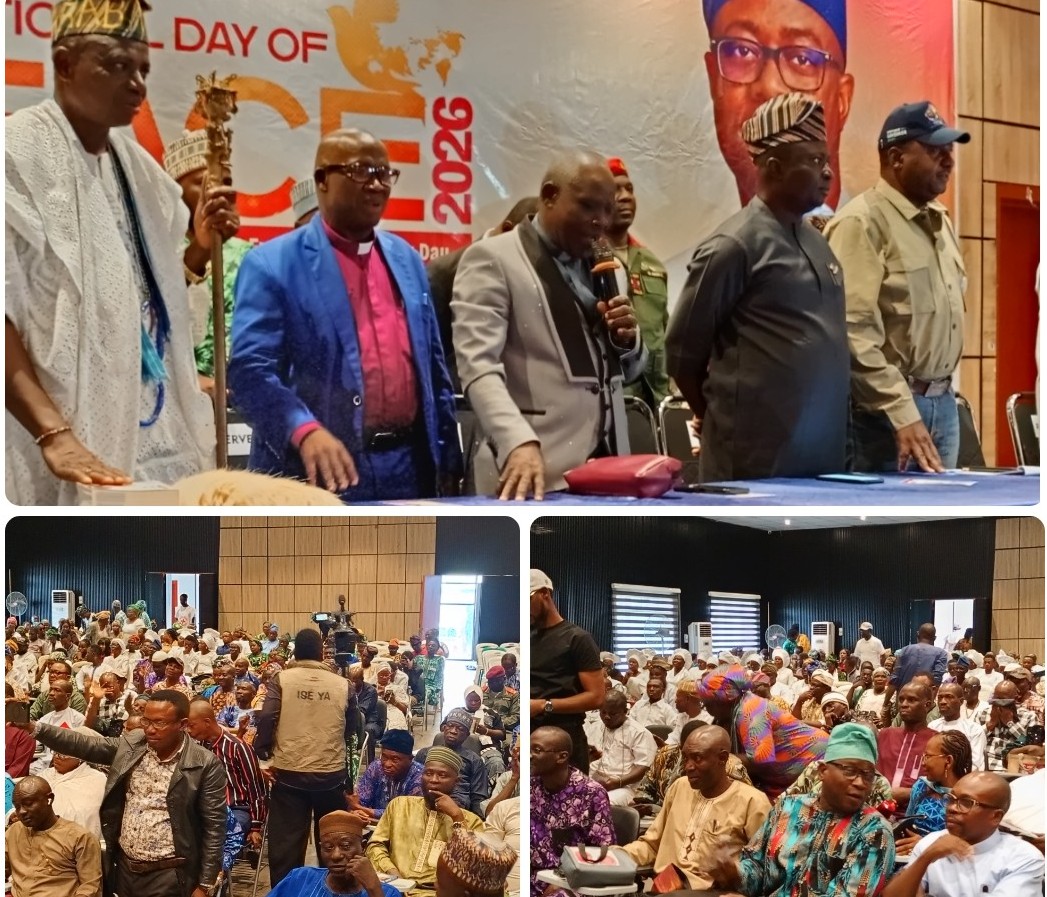
Religious leaders, government officials, political stakeholders and civil society organisations in Oyo State have called for sustained interfaith tolerance and peaceful coexistence, declaring that there can be no meaningful development in an atmosphere of religious suspicion, hatred and division.
The stakeholders made the call in Ibadan on Wednesday during a programme commemorating the 2026 World Peace Day.
The event drew a large turn out of clerics and representatives of the three major religious traditions in the state, as well as youth groups, civil society organisations and other critical stakeholders.
Speaking at the event, the Secretary to the Oyo State Government, Prof. Musibaudeen Babatunde, said the state had a long history of peaceful coexistence among Muslims, Christians and adherents of the traditional religion.
Babatunde, who recounted the historical relationship among the different religious communities in Oyo, said the state’s ability to maintain peace over the decades was an indication that religious diversity could coexist with social cohesion when properly managed.
He, however, charged religious leaders to take greater responsibility for the narratives emerging from their respective platforms, arguing that divisive messages from clerics could deepen tensions within society.
According to him, religious leaders must ensure that their sermons promote unity, responsible citizenship and peaceful coexistence rather than suspicion and division.
The SSG also expressed concern over the increasing abuse of drugs and other substances among young Nigerians, warning that the trend was destroying the lives and future prospects of promising youths.
He urged religious institutions to intensify their intervention among young people, stressing that properly channelled sermons and mentoring could help address several social ills confronting the younger generation.
Babatunde further suggested that interfaith programmes of the kind should be organised more frequently to deepen understanding among people of different faiths and create lasting impressions about the importance of peaceful coexistence.
Also speaking, the Allied Peoples’ Movement (APM) deputy governorship candidate for the 2027 election, Hon. Muftau Open Salawu, urged residents to reject all forms of divisive tendencies and narratives capable of threatening the peaceful atmosphere in the state.
Salawu said no society could achieve meaningful development where religious suspicion and disunity had taken root.
He also commended Governor Seyi Makinde for what he described as his support for the Muslim community despite being an active Christian, saying there are several visible records of the administration’s commitment to fairness and religious inclusiveness.
The APM deputy governorship candidate cautioned residents against allowing political competition to undermine the state’s longstanding tradition of religious harmony.
He noted that election periods often generated competing narratives from politicians, warning that some of such narratives could have consequences beyond politics if they exploited religious or ethnic sentiments.
He therefore urged the electorate to remain vigilant and carefully scrutinise political messages capable of threatening the peaceful coexistence among the people.
Salawu assured that an administration led by Bimbo Adekanbi would sustain and deepen peaceful coexistence and unity among Muslims, Christians and adherents of traditional religion if elected in 2027.
He also called for continued support for the APM and the Makinde administration, arguing that continuity of the state’s medium- and long-term economic development agenda was important to sustaining the gains recorded in recent years.
He maintained that any abrupt departure from the development trajectory under Makinde could undermine the progress already made and force the state to start rebuilding from the beginning.
The Chief Imam of Sango Central Mosque, Ibadan North, Alhaji Mustafa Bello, in his remarks, emphasised the need for religious tolerance, declaring that no individual had seen God and therefore had no basis for claiming religious superiority over another person.
Drawing references from the Quran, Bello called for renewed commitment to national unity, particularly among the people of Yorubaland.
He commended Makinde for what he described as being detribalised and fair to adherents of different religions, noting that the religious diversity of families across Ibadanland was itself evidence of the need for tolerance.
The cleric also distinguished between religiosity and genuine Godliness, arguing that the ultimate objective of every faith should be the fear of God and its reflection in people’s everyday conduct.
He condemned the activities of criminals who kill and abduct people in the name of Islam, insisting that such individuals did not represent Islam or the Muslim community.
Bello urged Muslims across the country to unite with their Christian brothers and adherents of other faiths to confront insecurity and other threats to peaceful coexistence.
In his keynote address, Ayobami Akinyode Olunloyo, son of the late former Oyo State Governor, emphasised the need to place humanity at the centre of religious practice.
Olunloyo cautioned against fanaticism and religious intolerance, stressing that genuine faith should promote compassion, understanding and respect for other human beings.
The keynote speaker captured the essence of the gathering with the declaration: “Peace is not something to hope for; it is something to intentionally invest in.”
Earlier in his welcome address, the convener of the event and Special Assistant on Interfaith Affairs to Governor Makinde, Reverend Femi Ibikunle described Makinde as an uncommon leader in contemporary Nigerian political environment.
He commended residents for resisting imported religious beliefs by those he described as religious extremists noting that the longstanding interfaith harmony in the state has become deeply rooted for divisive narratives to divide the people.
He stated that governor Makinde by all standard of measurements has shown the spirit of a pan Nigerian and pan African leader by ensuring that all the three major religious communities have a seat at the decision making table, a gesture he termed unprecedented in the history of the state.
He urged participants to be intentional about peace building and to ensure that they outrightly reject any candidate using religion as a political tool to canvas for votes saying development across the state do not recognize any religion.
“Humanity is the keyword, if we profess to love God but the humanity expected in us is not there, then we’re only being religious and not Godly,” Ibikunle said.
Other participants who spoke at the event included Araba Ifalere Odegbola, representing the traditional religion; Rev. Daniel Adesoji Ojo of the Christian Association of Nigeria; Comrade Alex Eniola, Oyo State chairman of the Youth Council; Apostle A. Olusoji of C&S Agbojesu Worldwide; Pastor Olujide Sunday, Oyo State Coordinator of IBBN; and Mr Adeniyi Aderemi Michael, President of the APM Christian Forum.
The programme recorded a massive gathering of religious leaders, youth representatives, civil society organisations and other stakeholders, who collectively renewed calls for religious tolerance, peaceful coexistence and responsible leadership as the state and country approach another election season.
The stakeholders maintained that sustaining Oyo’s tradition of interfaith harmony required deliberate efforts from government, religious institutions, political actors, traditional leaders, youths and ordinary citizens, stressing that peace remained a collective responsibility.
They however reaffirm their confidence in the leadership of governor Makinde whom they described as a unifier of the three major faiths in the state. They equally declared their support for continuity and good governance under the Makinde led sustainable development agenda.