

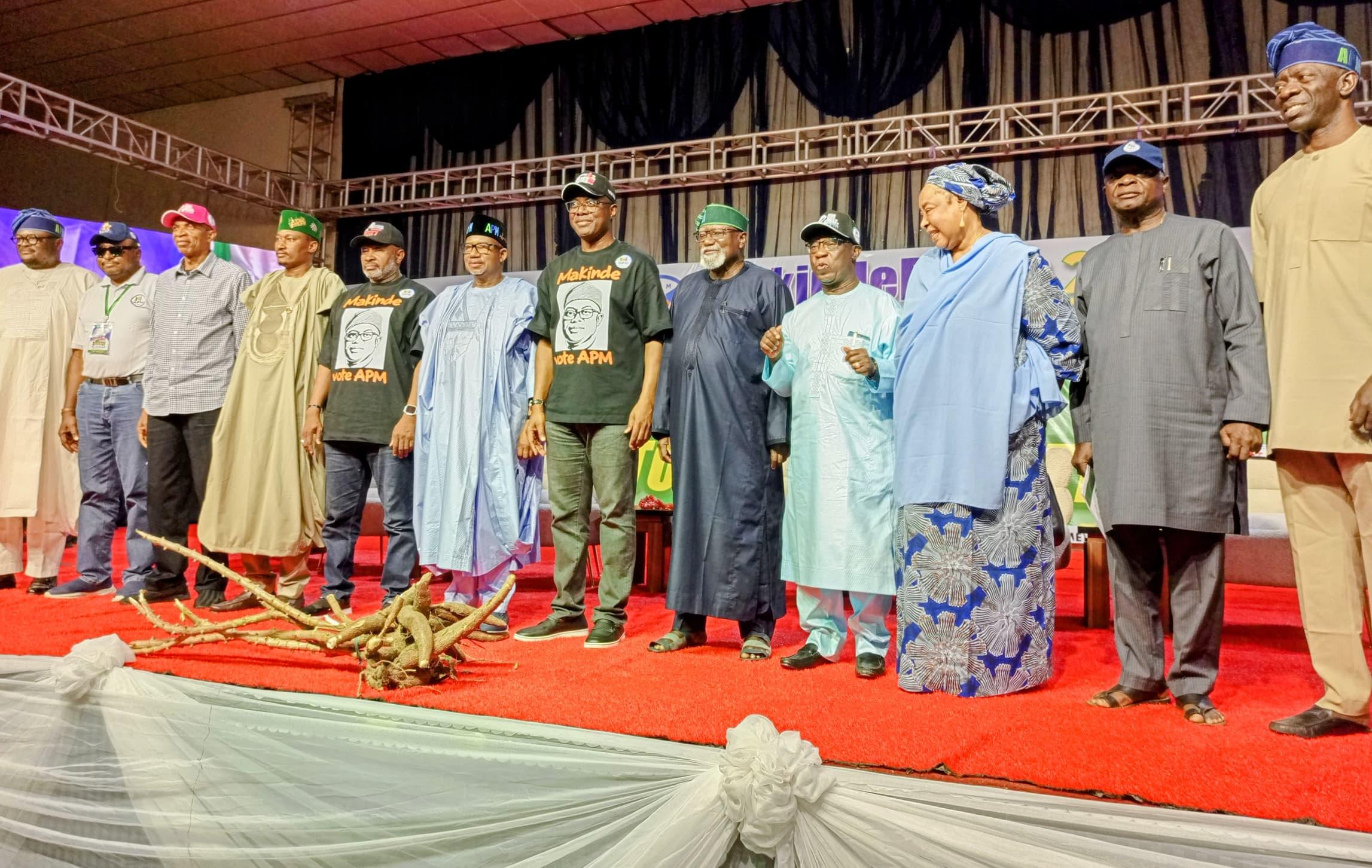
Governor Seyi Makinde of Oyo State has unveiled four cardinal pillars of his ‘Reset Nigeria’ agenda ahead of the 2027 presidential election, declaring that Nigeria needs a new direction anchored on education, security, economic productivity and a healthy sociopolitical environment.
Makinde, the presidential candidate of the Allied Peoples Movement (APM), said his proposed agenda was designed to move the country away from economic hardship, insecurity, nepotism and political exclusion towards a productive economy that would create opportunities for Nigerians across different regions and demographic spheres.
The governor also defended his decision to contest the presidency despite the presence of the incumbent president, also from the south west, while recalling that the region produced two presidential candidates, former President Olusegun Obasanjo and the late Oba Olu Falae, in the 1999 election without any crisis arising from their simultaneous participation in the race.
He argued that the precedent demonstrated that the Southwest could present more than one candidate for Nigerians to choose from, insisting that the 2027 presidential contest should be determined by competence, vision and the collective interest of the country rather than regional considerations or entitlement to political power.
Makinde spoke at an MakindeDaura2027Presidency Southwest Town Hall meeting in Akure, Ondo State, where he called on residents of the Southwest to support his presidential ambition and mobilise voters for the party ahead of the 2027 general election.
The governor urged supporters to obtain their Permanent Voter Cards (PVCs), embark on door-to-door campaigns and explain the party’s proposals to Nigerians, saying the country needed a government that would work for the majority rather than serve the interests of a privileged few.
He added that the proposed political transition would provide an alternative to continuing with the present direction of governance for another eight years, describing a government of national unity as the preferred option for Nigerians seeking a change in the country’s economic and political trajectory.
Addressing concerns about his decision to contest against another prominent political figure from the Southwest, Makinde questioned why age and regional representation should dominate discussions about the presidential election.
According to him, the more important consideration should be a candidate’s energy, physical capacity and ability to withstand the demands of governing a country as complex as Nigeria.
“Why are we making age an issue in this campaign? I will make energy an issue. Having the energy to stay up late, withstand the rigours, and deal with the challenges facing us as a country,” he said.
He challenged rival presidential candidates to demonstrate their physical fitness and readiness to undertake the responsibilities associated with the office.
“So, please, when they bring their own presidential candidates, let the candidates come here and jump down as well (while jumping down the from the stage in a show of physical fitness) saying: If they can do that, vote for them!”.
The governor maintained that the Southwest had historically played a leading role in Nigeria’s democratic development and should not be constrained by the argument that the region must rally behind a single presidential candidate because another person from the same zone occupies a prominent national position.
He cited the 1999 presidential election, when Obasanjo, the candidate of the Peoples Democratic Party (PDP), contested against Falae, who was jointly backed by the Alliance for Democracy (AD) and the All People’s Party (APP).
Both candidates were from the Southwest, following the political understanding that the presidency should return to the region after the death of General Sani Abacha and the transition towards civilian rule.
Makinde said the arrangement did not prevent the region from presenting its leading political figures to the Nigerian electorate.
“In 1999, when the entire Nigeria agreed to zone the presidency to the Southwest, we had two of our fathers, Baba President Olusegun Obasanjo and Baba Olu Falae, who contested the presidency. Both were from the Southwest, and heaven did not fall,” he said.
“As a matter of fact, what the Southwest did was to present two of its finest, two of its best, for Nigeria to choose from. Is there anything wrong with doing that this time around?
He further recalled that although the Southwest largely supported Falae in the election, the wider Nigerian electorate voted for Obasanjo, who eventually won the presidency.
Makinde argued that the outcome pinpoints the national character of presidential elections and the importance of allowing voters across the country to determine their preferred candidate.
“How do you have a Nigeria where somebody says, ‘Emilokan’? Okay, you were given the opportunity. If you take your mind back to 1999, the Southwest voted massively for Baba Olu Falae, but the rest of Nigeria voted for Baba President Olusegun Obasanjo,” he said.
He added that the question of who should lead Nigeria could not be resolved by the Southwest alone, stressing that all regions must participate in choosing a candidate capable of addressing the country’s challenges.
“This is not an issue that only the Southwest can solve. It is an issue we must solve collectively as Nigerians,” he said.
Unveiling the policy framework of his presidential ambition, Makinde identified education, economic productivity, security and the sociopolitical environment as the central areas requiring urgent national reform.
He said the proposed agenda would prioritise human capital development, improve the country’s security architecture, create a productive economy and protect democratic institutions.
The governor maintained that Nigeria could not achieve sustainable prosperity by relying solely on its natural resources or the distribution of revenue from the Federation Account.
He argued that a combination of skills, knowledge, security, infrastructure and an enabling political environment was necessary to unlock the country’s economic potential.
Education and skills development
Makinde said the first pillar of the Reset Nigeria agenda would be a comprehensive reform of the education system to equip Nigerians with the knowledge and skills required to compete in a modern economy.
He maintained that the availability of natural resources alone could not guarantee prosperity without a skilled and productive population capable of transforming those resources into economic value.
“First, we want to reset our educational system because, no matter the resources we have, the law of resources alone will not give us economic prosperity. We need skills and knowledge,” he said.
The governor’s position was that Nigeria must move beyond an economic model that places excessive emphasis on the availability of natural resources and instead invest in the capabilities of its people.
Under the proposed agenda, education would be central to preparing young Nigerians for employment, entrepreneurship and participation in emerging industries, while strengthening the country’s productive capacity.
Makinde argued that a country seeking to overcome poverty must first equip its citizens with the tools to contribute meaningfully to economic growth.
The second major component of the agenda, as outlined in his speech, focused on building a productive economy in which infrastructure would serve as a driver of growth and a means of addressing the concerns of young people and women.
Makinde said the country’s economic model must move away from excessive dependence on federal allocations and towards the development of multiple sources of revenue through productive activities.
In his words: “In Ondo State, in the Ilaje area, they say that when you have a riverine community and the tide rises, all the boats will rise,” he said. So, once we fix our economy and the tide rises, every boat will rise. No zone will be left behind. No demographic group will be left behind.”
The governor argued that an expanding economy would create opportunities for all regions, rather than concentrating development in areas favoured by the government of the day.
He criticised what he described as a ‘turn-by-turn’ approach to governance, in which political leaders prioritise projects in their own regions without ensuring that the projects are completed or deliver value to the wider population.
According to him, such an approach undermines continuity in public investment and prevents the country from fully benefiting from its resources.
“We do not want ten-by-ten nepotism. We also do not want a turn-by-turn arrangement where somebody says, ‘I will put a project in my zone because it is my turn.’ The project will not be completed, and when somebody else takes over, they will do the same thing. They, too, will not finish their projects,” he said.
Makinde maintained that infrastructure development should be guided by economic value, national priorities and the capacity of projects to generate opportunities, rather than political calculations or regional patronage.
He said the ultimate objective was to establish a system in which investments in infrastructure would stimulate production, expand economic activity and create a more sustainable path out of poverty.
The governor also urged policymakers to prioritise the productive capacity of citizens rather than imposing taxes on people who were already struggling economically.
He recalled making a similar argument at a National Economic Council meeting, where he called for policies that would enable Nigerians to become productive before placing additional tax burdens on them.
“I said, ‘Please, let the people be productive. When they are productive, they become prosperous. When they are prosperous, prosperity will follow. Don’t tax poverty,’” he said, adding that the Reset Nigeria agenda was intended to pursue prosperity rather than perpetuate poverty.
According to Makinde, a productive economy would provide opportunities for young people, women, businesses and communities to generate wealth without depending entirely on government transfers.
The governor also renewed his demand that funds due to state and local governments from Nigeria LNG Limited dividends should be released to the appropriate tiers of government.
He argued that greater access to resources by states and local governments would help them address development challenges within their jurisdictions, while a more productive national economy would reduce their dependence on revenue allocations.
“I mentioned the other day that the Federal Government has been spending the NLNG dividends alone. Send whatever is due to the states and local governments to them. I am still repeating it, please,” he said.
Makinde stated that reconciliation on the issue had been carried out, reiterating his position that states and local governments should receive the amounts due to them.
The governor argued that Nigeria should develop an economy capable of generating wealth through production, enterprise and investment, thereby giving governments at all levels more sustainable sources of revenue.
He said federal allocations should no longer be the principal foundation of economic survival for states and local governments.
“The Reset Nigeria agenda envisages a Nigeria where, as they would say in Ibadan, federal allocation will be aró kù bí aṣọ bá gbàgi,” he said, using a Yoruba expression whose exact wording and intended meaning require confirmation.
He maintained that a productive economy would create several avenues for governments and citizens to move from poverty to prosperity.
The governor’s position places economic productivity at the centre of his proposed reforms, with revenue distribution serving as an immediate governance issue while production, investment and employment creation remain essential to long-term national development.
Makinde also criticised the Federal Government over what he described as uncertainty surrounding the national budget and questioned the expenditure involved in the presentation of the United Nations budget to the President in Abuja by Nigeria’s Permanent Representative to the UN.
He argued that the presentation raised questions about the use of public funds, particularly at a time when, according to him, Nigerians lacked clarity about the budget being implemented by the Federal Government.
“They can waste taxpayers’ money, because I refuse to agree that taxpayers’ money must be used to fly from New York to Abuja to present the UN budget,” he said.
He added: “When, indeed, this is an administration where, right now, we do not even know which budget it is operating on in Nigeria. Is it the 2023, 2024, 2025 or 2026 budget? And then they come with the UN budget and say, ‘Look, this is the UN budget.’
The governor contrasted his criticism of the Federal Government with what he described as Oyo State’s record of improving budget performance and maintaining a predictable annual budget cycle under his administration.
He said that when he assumed office, the state had a budget performance record of between 28 and 30 per cent.
According to him, his administration subsequently raised budget performance to more than 70 per cent over seven-plus years through sustained improvements in planning and implementation.
“When I became governor, we met a budget performance record that had always been between 28 and 30 per cent. We sat down, and for the past seven-plus years, budget performance in Oyo State has risen to over 70 per cent,” he said.
“It is not a one-year achievement. It is something we do year in, year out.”
Makinde further stated that his administration had consistently operated the state’s budget from January to December, with budget proposals usually presented to the Oyo State House of Assembly between November and December.
He said the legislature typically passed the budget in early December, allowing implementation to begin in January of the following year. “For the past seven-plus years, we have operated our budget in Oyo State from January to December. Check the records,” he said.
“I have always presented the budget to the State House of Assembly, mainly within the November-December period. Usually, the budget is passed in early December, and by January of the following year, we start operating it in our state.”
The governor cited the state’s budgetary process as an example of the planning and fiscal discipline he believes should underpin national governance.
Makinde identified security as another central pillar of the Reset Nigeria agenda, saying the country needed a restructured security architecture capable of protecting citizens, businesses and economic activities.
He argued that insecurity had restricted economic activities in many parts of the country and that a secure environment was necessary for businesses to operate for longer hours, create jobs and contribute to national growth.
The governor said he would work with his running mate, Alhaji Lawal Daura, whom he described as a security expert, to address the country’s security challenges.
“Second, we will reset our security architecture. A security expert is seated out there, and by God’s grace, he will be the next Vice President of the Federal Republic of Nigeria,” he said.
“Together, we will work on Nigeria’s security architecture so that our economy will not shut down at 8 p.m. We will expand our economy.”
His remarks linked security reform directly to economic development, with the argument that improved safety would allow businesses, transport operators, service providers and other economic actors to operate with greater confidence.
Makinde’s proposed approach was that the country must create conditions in which security challenges do not continually restrict productive activities or discourage investment.
He maintained that a more secure Nigeria would be better positioned to expand its economic base and create opportunities for citizens.
The fourth pillar of the agenda focused on the sociopolitical environment, with Makinde expressing concern about what he described as attempts to weaken opposition parties and restrict democratic competition.
He said Nigeria’s founding political leaders had worked hard to establish federalism and multiparty democracy, arguing that those principles must be protected if the country was to sustain democratic governance.
The governor questioned why a ruling party with control of several state governments and significant instruments of political power would be apprehensive about the activities of opposition parties.
“Our forefathers worked really hard to give us federalism and multiparty democracy. I do not understand how a party in power, with 31 governors and almost all the instruments of coercion, can still be afraid of the opposition and refuse to allow opposition parties to thrive,” he said.
He argued that political competition should be permitted to flourish regardless of whether a state is governed by the opposition or by a party aligned with the Federal Government.
According to him, opposition parties should be able to organise, campaign and present their programmes without interference designed to create internal crises or undermine their operations.
“Go to all your states. Whether you are in the opposition or belong to the same party as the ruling party in your state, the political space is completely open. That is what we demand from the Federal Government,” he said.
“Stop using the back door to cause crises in opposition parties. There is no democracy if we have a one-party system.”
Makinde’s comments amounted to a call for stronger protection of political pluralism, with the governor insisting that a democratic system must provide room for competing political parties and alternative policy proposals.
He also rejected the politics of entitlement and nepotism, arguing that national leadership should not be organised around the assumption that political power belongs to a particular individual, group or region at a given time.
He said the country needed a political arrangement that would encourage fairness, national inclusion and a shared commitment to development.
Other leaders of the APM at the event also criticised the economic policies of the ruling party, which they blamed for the hardship experienced by Nigerians across various sectors.
The South-West Coordinator of the party, Chief Eddy Olafeso; the National Chairman, Yusuf Dantalle; and the National Leader, Senator Bala Mohammed, expressed confidence in the party’s ability to provide an alternative to the current administration.
They said the APM’s presidential ticket, comprising Makinde and Daura, offered an opportunity to address the country’s economic and security challenges and restore confidence in governance.
The party leaders called on Nigerians to consider the APM’s proposals ahead of the 2027 election, expressing the belief that the country could recover from its present difficulties through a change in leadership and policy direction.
Their remarks reinforced the central message of the campaign: that Nigeria needed a government focused on economic productivity, national inclusion, security and democratic accountability.
Daura warns against infiltration of APM
Speaking at the event, the APM vice-presidential candidate, Daura, said the party’s leadership was prepared to assume responsibility for governing the country and tackle its numerous challenges.
He expressed confidence in the party’s readiness for the 2027 election but warned against political actors who might attempt to infiltrate its ranks and create divisions.
Daura insisted that the APM remained united, resolute and committed to its political mandate, adding that the leadership would not allow external interference to undermine the party’s cohesion.
He urged members and supporters to remain committed to the party’s objectives and avoid actions capable of weakening its internal unity.
Oyinlola, Ciroma, Ogunbambi urge youths to support change
Other speakers, including former Osun State Governor, Prince Olagunsoye Oyinlola; APM Deputy Director-General (Administration), Hajia Maryam Inna Ciroma; and retired civil servant, Dr Layi Ogunbambi, called on Nigerian youths to respond to the party’s campaign for political change.
They urged young people to support candidates they considered energetic, visionary and capable of confronting the country’s challenges.
The speakers also expressed concern over the state of democracy in Nigeria, alleging that the ruling government was weakening opposition parties and undermining the conditions required for a vibrant multiparty system.
They called on Nigerians to unite in defending democratic institutions and ensuring that opposition parties retained the freedom to participate fully in the electoral process.
Their appeal reflected the APM’s effort to present the 2027 election as an opportunity not only to change the country’s economic direction but also to strengthen its democratic foundations.
Makinde calls for door-to-door mobilisation
Concluding his address, Makinde urged APM supporters across the Southwest to take the party’s message directly to households, communities and voters ahead of the election.
He called on supporters to distribute campaign materials, engage residents and explain how the Reset Nigeria agenda would address the challenges facing the country.
“So, finally, I appeal to the people of the Southwest: let us go out and spread this message. Take your flyers and go from door to door. You will be well received because the people want a reset. So, go out there, meet the people, convince them and explain the Reset Nigeria agenda to them.”
He urged Nigerians to obtain their PVCs and participate actively in the electoral process, describing voter participation as essential to achieving the change being proposed by the party.
The governor said the central choice before the electorate in 2027 would be whether to maintain the existing direction of governance or embrace a transition to a government of national unity.
“But the main message is that the rest of Nigeria will choose between continuing on the same path for another eight years and embracing a transition to a government of national unity. If the answer is that we want a new direction, then let us prepare for a transition to a government of national unity,” he said.
Makinde concluded by urging the Southwest to take a leading role in the campaign for what he described as a national rebirth, insisting that the proposed reforms would benefit all regions rather than a select group of political or economic interests.