

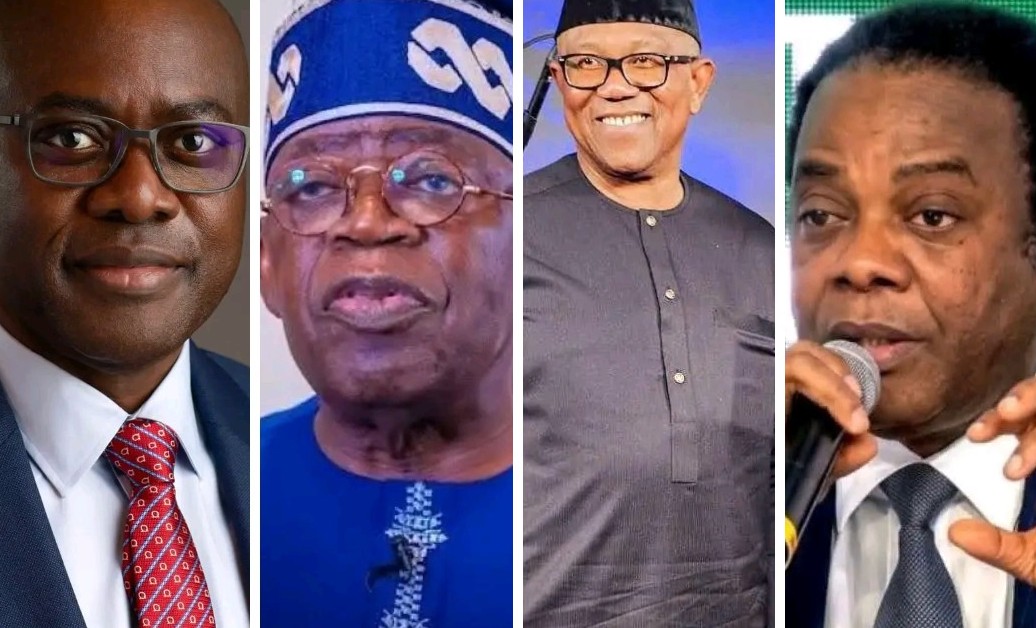
The All Progressives Congress (APC) appears to be advancing a political narrative that seeks to make President Bola Ahmed Tinubu’s re-election bid synonymous with the political interest of the entire Southern Nigeria.
It is a narrative that deserves to be challenged because it blurs the distinction between the legitimate argument for power rotation and the personal ambition of a presidential candidate.
The latest attempt to push this narrative came from former Senator Smart Adeyemi, who warned that Nigeria could face a serious political crisis if the North attempts to reclaim the presidency in 2027 before Tinubu completes eight years in office.
Adeyemi, who spoke shortly after his inauguration as Director-General of the APC Presidential Campaign Council in Kogi State, argued that the South supported former President Muhammadu Buhari for two terms and should therefore be allowed to complete its own eight-year presidential tenure under Tinubu.
His argument may appeal to those who believe strongly in the principle of power rotation, but it leaves out a crucial question: Must the political future of Southern Nigeria revolve exclusively around Tinubu and the APC?
There is a clear difference between insisting that the South should complete an eight-year presidential cycle and demanding that Tinubu must be the only Southern politician entitled to benefit from that arrangement.
The former is an argument about regional balance; the latter is an attempt to turn a national political convention into an exclusive electoral entitlement.
The APC must understand that Southern Nigeria is not a political party, and Tinubu is not the sole political representative of the region.
The South comprises different geopolitical zones, political interests, parties, ideologies and individuals who are equally entitled to seek the mandate of Nigerians.
The southern Nigeria has the South-South, South East, and the South West. Tinubu is from the last region, and indeed, the 2027 presidential contest has other prominent Southern candidates.
The APC’s argument on side is against the North fielding a candidate against the incumbent on account of the unwritten rotational arrangement while on the other hand, the ruling party is attacking other candidates from the south who are also contesting for the number one office in the land.
The one critical question begging for answer now going by the APC’s arguments is; should Nigeria stop to conduct presidential election anytime an incumbent is seeking another term of office?
Apart from Tinubu, former Anambra State Governor Peter Obi of the Nigeria Democratic Congress (NDC), Oyo State Governor Seyi Makinde of the Allied Peoples Movement (APM), former Cross River State Governor Donald Duke of the Peoples Redemption Party (PRP), and Sandy Ojang Onor of the Peoples Democratic Party (PDP) are among those on INEC’s published list of presidential candidates.
These are Southern politicians with their own political platforms and ambitions. Their decision to contest the presidency cannot reasonably be interpreted as an attempt to undermine the South or deny the region its place in the country’s power arrangement.
The question, therefore, is why the APC appears uncomfortable with the prospect of other Southern candidates competing for the same office. If the argument is genuinely about ensuring that power remains in the South for another four years, why should that opportunity automatically belong to Tinubu?
The APC with this narrative is working tirelessly to push a narrative that presents the presidency as a personal inheritance of the incumbent president while disregarding the freedom of choice of millions of Nigerians at the poll.
There is nothing wrong with the APC campaigning for Tinubu’s re-election. It is a political party, and its responsibility is to defend its candidate and persuade Nigerians to vote for him.
What is unacceptable, however, is the attempt to present his re-election as a regional obligation and portray those who support other candidates as working against the interests of Southern Nigeria.
Tinubu, who hails from the South West, is the APC’s presidential candidate, not the presidential candidate of every Southern Nigerian. His ambition should be assessed on its own merits, just as the ambitions of other candidates should be judged by their records, programmes, experience and capacity to lead the country.
A Southerner who chooses to support Peter Obi, Seyi Makinde or another candidate from the region has not betrayed the South. Such a person is simply exercising a Constitutional and democratic right.
The principle of unwritten power rotation, which has become an important feature of Nigeria’s political negotiations, is meant to promote inclusion, fairness and a sense of belonging among the country’s different geopolitical interests.
It was never intended to establish a personal ownership of the presidency or prevent other qualified politicians from other parties or region, from competing for the office.
Even if the argument that the South should complete eight years after Buhari’s two terms is accepted, it does not automatically follow that Tinubu must be the beneficiary like the APC is trying to push the narrative.
That question should be left to the democratic process and the Nigerian electorate to decide who their next leader should be or where he hails from.
The APC cannot preach fairness and equity while attempting to monopolise the political identity of an entire region.
Power rotation should not become a weapon against democracy
Adeyemi’s reference to the South’s support for Buhari between 2015 and 2023 is not without political relevance.
The South participated in the electoral process that produced Buhari’s two terms, and the argument for maintaining the informal North-South power arrangement is one that can be debated.
But there is a difference between recognising that political understanding and using it to demand unquestioning support for a particular candidate.
Nigeria’s Constitution does not provide for an exclusive presidential entitlement based on geopolitical zones. Although political parties and stakeholders have adopted zoning arrangements to promote national balance, such arrangements cannot override the constitutional rights of Nigerians to contest elections and choose their leaders.
More importantly, the principle of rotation should not become an excuse for avoiding questions about governance and performance.
If Tinubu deserves another four years, the APC should make a convincing case for his re-election based on what his administration has achieved, the challenges it has addressed and its plans for the future.
The party should be prepared to defend its economic policies, security record, infrastructure projects, employment figures and the impact of its decisions on the living conditions of ordinary Nigerians.
These are the issues that matter to families struggling with rising food prices, transportation costs, school fees, healthcare expenses and the general pressure of making ends meet.
Regional sentiment may influence political calculations, but it cannot replace the responsibility of a government to account for its stewardship.
It is also important to put Adeyemi’s remarks in their proper context. He was speaking as the Director-General of the APC Presidential Campaign Council in Kogi State. His responsibility is to mobilise support for Tinubu, and his comments should be understood as part of that political assignment.
However, Nigerians should be wary of the suggestion that the country could descend into crisis simply because another political interest seeks power in 2027.
A democracy cannot be built on the assumption that one individual must remain in office to guarantee national stability. The country’s unity should rest on respect for the Constitution, credible elections, strong institutions and the willingness of political actors to accept the people’s decisions.
If every political disagreement over presidential succession is presented as a threat to national peace, then the very essence of democratic competition is being undermined.
Nigeria belongs to all its citizens. Neither the North nor the South should be made to feel that its political survival depends on the ambition of a particular politician.
Adeyemi’s warning may be intended to strengthen Tinubu’s re-election campaign, but it should not be mistaken for an objective assessment of what Nigeria needs to remain united on a political course.
Another aspect of Adeyemi’s remarks that deserves scrutiny is his argument that Kogi State should support Tinubu because the President has appointed indigenes of the state into strategic federal positions.
He specifically mentioned the appointment of a Kogi indigene as Chief of Army Staff, another as head of the Federal Fire Service and two ministers from the state.
While such appointments may be a source of political satisfaction to the people of Kogi, they should not be presented as why the state’s residents have no choice but to vote for Tinubu.
Federal appointments are made in the interest of the Nigerian state. They are not personal favours to be exchanged for electoral loyalty, nor should the appointment of individuals from a particular state be interpreted as an obligation on the entire population to support the appointing administration.
The people of Kogi, like other Nigerians, have every right to examine the performance of the Tinubu government and make their own electoral decisions.
Adeyemi’s declaration that Kogi has no choice but to vote for Tinubu, 100 per cent, is particularly concerning. In a democracy, the electorate must always have a choice. That is why elections are contested in the first place.
There is another contradiction in Adeyemi’s intervention. He urged Nigerians to examine the character, competence, experience and leadership records of all presidential contenders before deciding whom to support.
That is a reasonable position. But it must apply equally to President Tinubu.
If Nigerians are expected to scrutinise the antecedents of opposition candidates, they must also be free to scrutinise the performance of the incumbent president.
No candidate should be shielded from public assessment simply because he comes from a particular region or represents a party that currently controls the Federal Government.
The APC cannot demand performance-based assessment for its opponents while asking Nigerians to approach Tinubu’s re-election primarily through the sentiment of Southern solidarity.
Ultimately, the 2027 election should be about competing ideas, credible programmes, leadership capacity and the ability of candidates to address the problems confronting the country.
Tinubu is constitutionally entitled to seek another term, just as other Southern politicians are entitled to contest against him. Northern politicians and voters are equally entitled to participate in the process without being portrayed as enemies of Southern interests.
The APC should therefore stop trying to make Tinubu’s re-election synonymous with the survival of Southern Nigeria’s political interest. The region is bigger than one politician or geopolitical zone, just as the country is bigger than any political party.
If Tinubu has performed well enough to deserve another term, the APC should convince Nigerians with evidence and a credible record of governance. If other candidates have better alternatives, they should also be allowed to make their case before the electorate.
The final decision belongs to Nigerians, not campaign directors, political pressure groups or those who seek to speak for an entire geopolitical zone.
The truth is very simple even at this stage: Southern Nigeria has a legitimate stake in the country’s power-sharing arrangement, but that stake does not belong exclusively to any one individual.
The South comprising three geopolitical zones, has a right to the presidency, but Tinubu, like other presidential candidates, does not have an exclusive right to represent the South.