

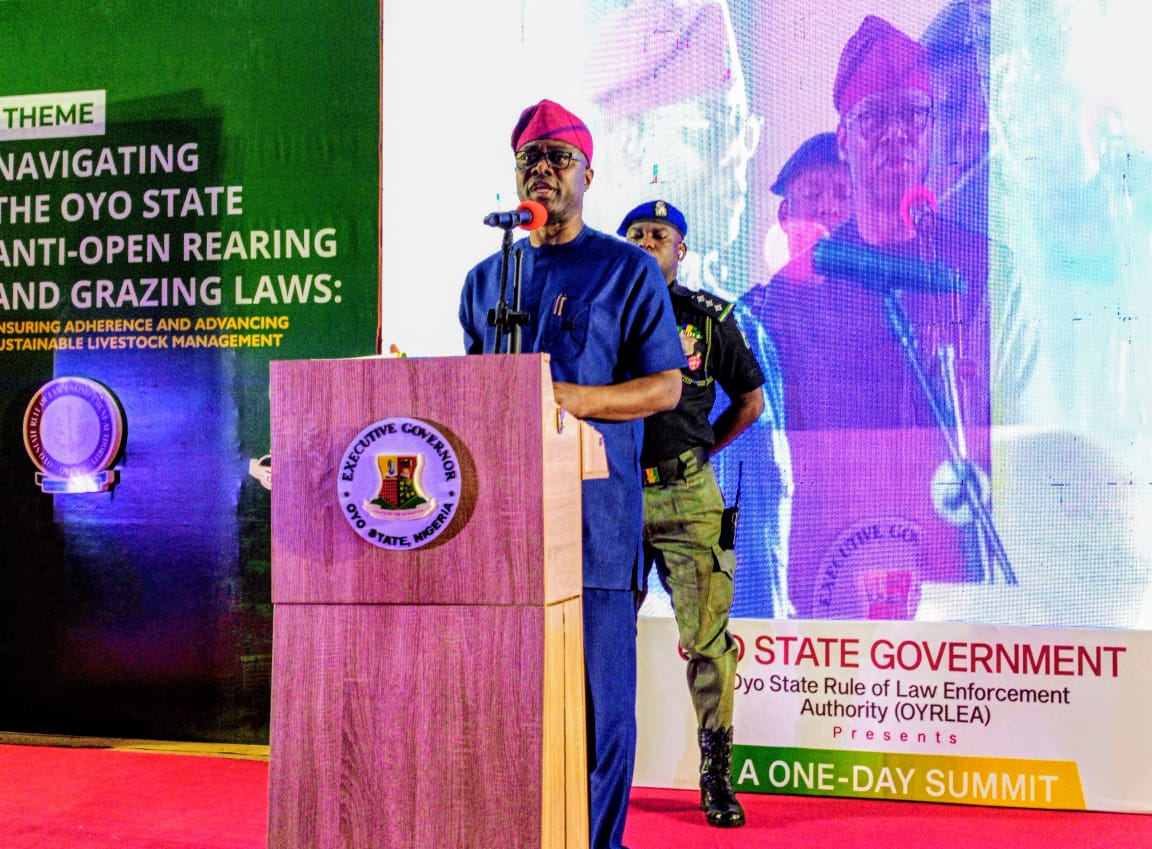
Oyo State Governor, Seyi Makinde, has explained the circumstances that made it impossible for his administration to work with local government chairmen elected under the previous All Progressives Congress, APC, government.
He linked the crisis to constitutional breaches and what he described as political “games” around local government autonomy.
Makinde stated this today at a program organized by the Oyo State Rule of Law Enforcement Authority tagged “Navigating The Oyo State Anti-Open Grazing Law: Ensuring Adherence amd Advancing Sustainable Livestock Management”.
Reflecting on his early days in office and national debate on local government autonomy, the governor insisted that his decisions were guided by constitutional order, fairness and long term stability rather than partisan sentiment.
The governor recalled that during his 2018–2019 campaign, he openly told voters that he intended to scrap Local Council Development Areas, LCDAs, because they are not recognised by the Nigerian Constitution, which provides for 774 local government areas nationwide.
According to him, the creation of LCDAs was popularised in Lagos and later encouraged in some South West states when those he said were promoting the policy wielded political influence, only for the same actors to later emerge as champions of full local government autonomy.
“Today, they are saying local governments should receive allocations directly from the federal government. But when they created LCDAs, what was the intention then?” Makinde queried.
Speaking further, he said, “that is not consistency. That is gaming the system. In Oyo State, we do not play games.”
He said his position was anchored on problem solving rather than political convenience, noting that he had made it clear to voters that scrapping LCDAs was part of his reform agenda, even if it cost him electoral support.
However, Makinde explained that he later reconsidered his stance after community leaders made representations to him about the historical and social realities in some areas. He cited an example of an LCDA predominantly inhabited by up to a third generation of Fulani residents, where the council structure, from chairman to councillors, reflected that unique demographic composition.
“They told me that LCDA was the only administrative structure where those people felt represented, so we changed our approach. We did not scrap the LCDAs,” he said.
Instead, the governor said his administration opted for what he described as a justice based solution by allowing the main councils and LCDAs to coexist under a regulated framework.
Makinde also shed light on the legal battles that followed his assumption of office, particularly over local government elections conducted by the immediate past administration.
He said elections were held not only into constitutionally recognised local governments but also into LCDAs, a move he considered unlawful.
“That was the only reason I said I could not work with those chairmen. You cannot conduct elections into LCDAs as if they are constitutional local governments. It creates confusion and administrative disorder,” Makinde said.
He disclosed that the matter ended up in court and led to a tense legal confrontation, which later evolved into mutual respect between his government and the judiciary, driven by a shared interest in stability and the rule of law.
Makinde stressed that his actions were never personal but institutional, and aimed at correcting structural flaws inherited by his administration.
In his words: “At that point, I was looking for stability and a lawful way to reset the system. They left an opening, and I used it to restore order.”
The governor reaffirmed his commitment to genuine local government reform, saying autonomy must be pursued with honesty, constitutional fidelity and a clear understanding of Nigeria’s complex social realities.