

In Temidire, a quiet community tucked within Eruwa in Ibarapa East Local Government Area, education used to begin with hope and often end in hesitation.
Children would complete primary school brimming with ambition, only to confront a harsh reality. There was no secondary school in their community. For many, that was where the journey ended but last Tuesday, that narrative shifted.
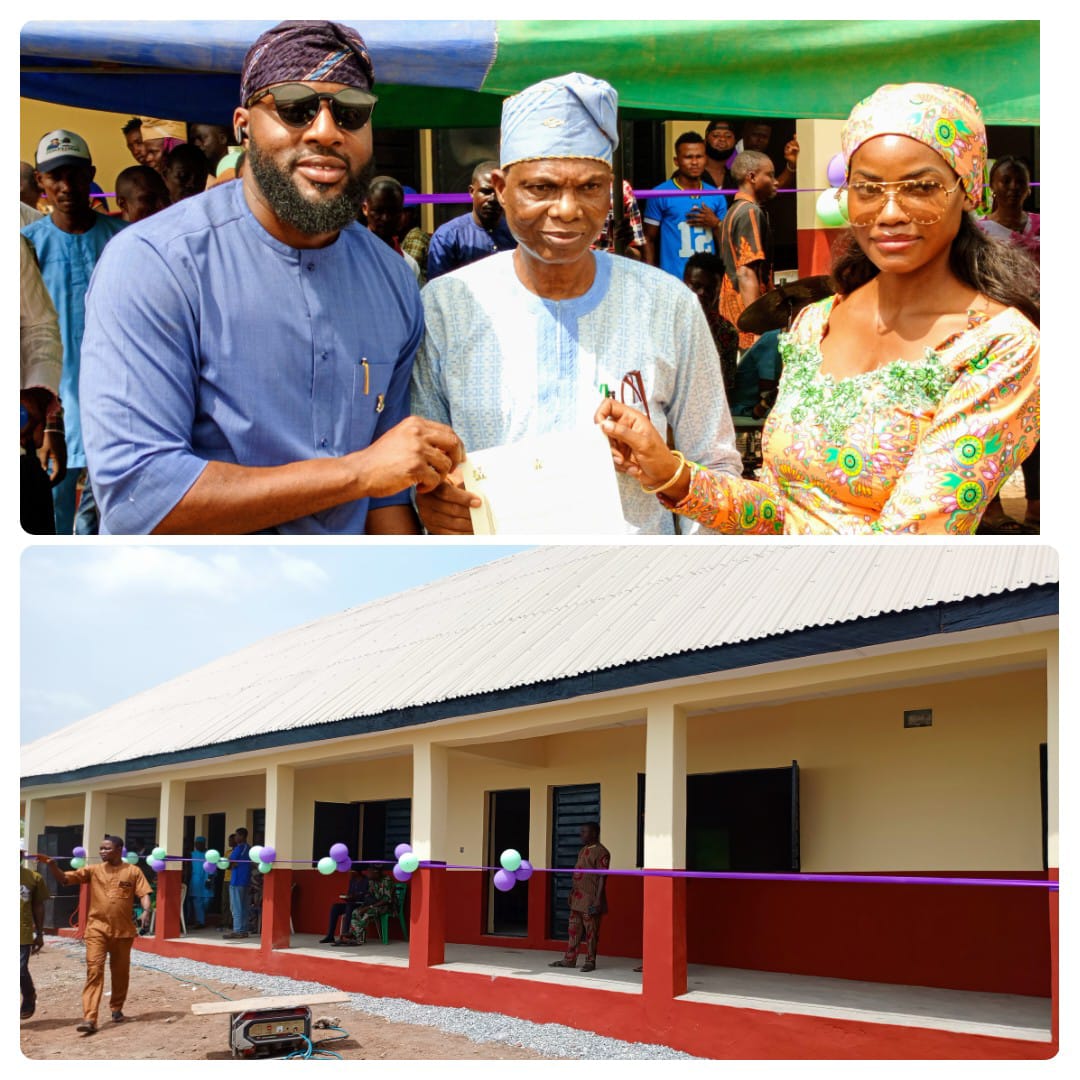
The Speaker of the Oyo State House of Assembly, Adebo Ogundoyin, commissioned and handed over a newly constructed, fully furnished secondary school to Temidire Community.
It is the first of its kind in a cluster of about 46 villages that, until now, had no direct access to post primary education.
The event coincided with his 39th birthday. It was symbolic. But more than symbolism, it was substance.
Standing before residents, traditional leaders, teachers and students, Ogundoyin described the project in simple terms. Promise made. Promise kept.
Before this school, children who completed primary education in Temidire’s two private and eight public primary schools had to travel roughly 30 minutes by motorcycle to Eruwa township. Some even crossed into neighbouring Ogun State. The journey was not just long. It was uncertain.
A teacher who spoke at the ceremony painted a picture that many in the crowd did not need explained. Pupils would wake early, put on their uniforms, and then wait. They waited at junctions for vehicles that might not come. They waited through the first and second periods, often missing English and Mathematics. They waited in the afternoon too, sometimes until 6pm, hoping for a ride back home.
A child who returns home exhausted at dusk after standing by the roadside is less likely to repeat the experience the next day. Over time, the waiting becomes withdrawal. School becomes optional. The farm becomes practical.
That was the quiet crisis Temidire lived with for years.
Exposed to risks on lonely roads, parents worried, teachers lamented, community leaders wrote letters, all to no avail under successive past administrations. Nothing changed. Perhaps for reasons that some alluded to politics.
For over two decades, according to Chief Olatunji Adio, the Otun Olori of Temidire, appeals to successive administrations for a secondary school yielded no result until Ogundoyin took the bull by the horn and stepped in. To them, the project represents more than education infrastructure, it is a lifetime legacy that generations yet unborn will benefit from.
The newly commissioned school is not a token structure hurriedly assembled for applause. It comprises two blocks of well ventilated classrooms. They include a principal’s office and staff rooms, modern toilet facilities with running water, and a motorised borehole to serve the school community.
The classrooms are fully furnished and academic activities are already scheduled to commence in September 2026.
Beyond infrastructure, there was a visible sense of readiness. School bags, textbooks and writing materials were distributed to pupils. It was another assurance that the building would not stand empty.
For Ogundoyin, the project traces back to his 2023 electioneering campaign, when residents openly lamented the absence of a secondary school. He listened. The school, he said, was conceived from that conversation.
In a political culture often criticised for rhetoric heavy and delivery light, the Temidire project offers a counter example. It ties representation to responsiveness by the first youngest Speaker in Oyo state and the chairman of Nigeria Conference of Speakers of the 36 states in Nigeria.
At the ceremony, Chairman of the House Committee on Education, Hon. Femi Fowokanmi, made a pointed observation. If the Speaker had handed out cash, even a generous sum, the impact would have been fleeting. A school, he argued, outlives the moment. It multiplies opportunity across generations.
That perspective aligns with the wider policy direction of the administration of Seyi Makinde. Represented at the event by the Commissioner for Education, Science and Technology, Hon. Olayiwola Olusegun, the governor commended the Speaker for what he described as leadership by example.
Makinde reiterated that investment in education remains the most rewarding commitment any government or individual can make.
According to him, Oyo State’s ongoing reforms include recruitment of teachers, free textbooks for public school students, distribution of WASSCE past questions to SS3 students in both public and private schools, digital learning initiatives and continuous teacher training.
He noted that these interventions are already reflecting in improved performance in national examinations and in the state meeting key UNESCO benchmarks, including education budget allocation and student teacher ratio.
The Temidire school fits into that larger ecosystem. It is local in execution but systemic in implication.
The Speaker used the occasion to list other interventions across Ibarapa East Constituency. A primary health centre at Lagaye. Boreholes across communities. Youth empowerment initiatives. Another secondary school project nearing completion in Ojonamo, Lanlate.
These projects collectively reflect a model of constituency driven development, where legislative influence is translated into tangible social infrastructure.
Yet the Temidire school stands out for its emotional weight. It addresses not just a development gap but a psychological one. For years, children in the area internalised distance as destiny. Secondary education felt far, literally and figuratively. Now, it stands within walking distance.
In development discourse, statistics often dominate. Budgets, ratios, rankings. They matter. But sometimes progress is best measured in smaller scenes such as the Ogundoyin’s gesture to Temidire community.
A child who no longer chooses between schooling and farming, a teacher who no longer watches pupils drift away, and a community that waited twenty years and finally sees brick and mortar finally answer its letters.
In Temidire, a promise has become a school. And for 46 villages, that school may well become a collective future dwellers dreamed of.