

There was a time when the Peoples Democratic Party felt almost permanent in Nigerian politics.
From 1999 to 2015, the party governed the country without interruption. It produced presidents, controlled most state governments, and commanded overwhelming influence across the National Assembly.
For many Nigerians, the PDP was not just a political party. It was the political system itself. So much that a former PDP national chairman once bragged about how the party would remain in power for the next 60 years.
Today that same party appears locked in a bitter internal war that threatens to finish what the 2015 electoral defeat started.
At the centre of the crisis is a long and exhausting battle for control of the party structure.
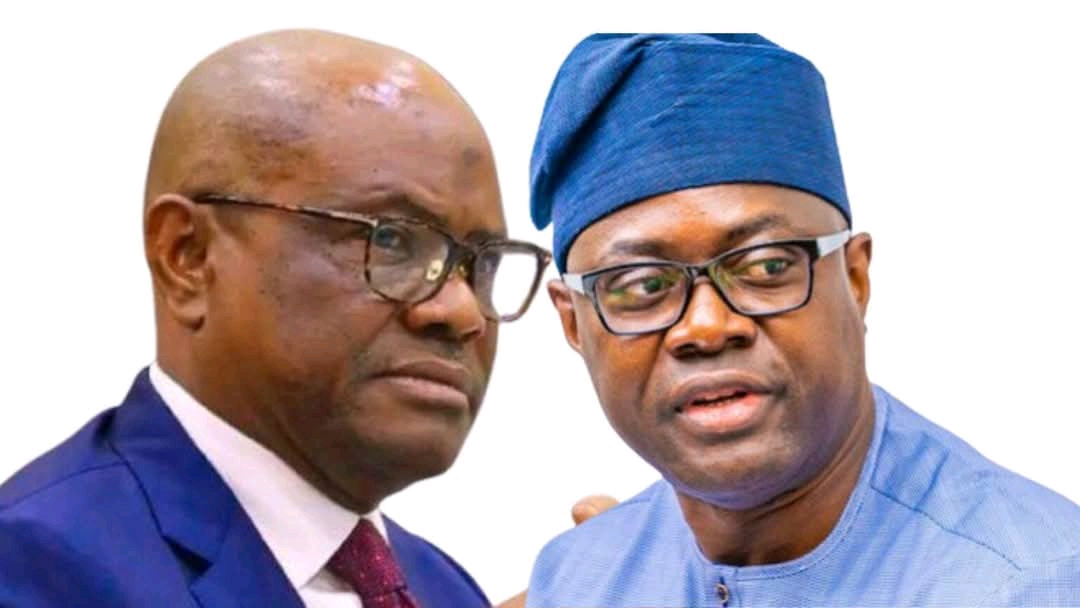
The conflict has pitched powerful political actors against one another, particularly the camps associated with Seyi Makinde and Nyesom Wike.
What began as internal disagreement has gradually turned into a full scale struggle over legitimacy, influence, and ultimately the future of the party.
Behind the noise of court cases, suspensions, and rival conventions lies a larger question that many party loyalists are beginning to ask quietly but seriously.
Political parties everywhere have disagreements. That is normal. But what the PDP is experiencing now goes far beyond routine disagreement.
Over the past few years, the party has become deeply divided between powerful blocs within its leadership.
On one side are governors and party figures who believe the party must rebuild quickly and present itself as a credible national opposition.
On the other side are leaders who feel sidelined and insist the internal power balance of the party must first be corrected.
The rivalry between Makinde and Wike has become the most visible symbol of that division.
Makinde, the governor of Oyo State, has emerged as one of the most influential voices pushing for the rebuilding of the party’s national structure after the bruising 2023 elections.
His allies argue that the PDP must reposition itself quickly if it hopes to challenge the ruling government in the next electoral cycle.
Wike, the former governor of Rivers State and now a minister in the federal government, represents another powerful network within the party.
His supporters insist he remains one of the party’s strongest political mobilisers and cannot simply be pushed aside.
The problem is that the relationship between the two camps has steadily deteriorated from political disagreement into open verbal hostility.
One of the most troubling aspects of the PDP crisis is the extent to which internal party disputes have migrated to the courts.
Instead of resolving disagreements through internal mechanisms, factions now routinely seek judicial intervention to determine who controls the party structure.
Party executives are suspended and reinstated through court orders. Decisions taken by one faction are immediately contested by the other. Decisions easily challenged in court over issues that could be resolved internally.
In practical terms, the courts have gradually become the place where the real battles over the PDP’s leadership are fought.
For a party already struggling to regain national momentum, this constant legal warfare has come at a heavy cost.
Energy that should have been directed toward policy debates and political mobilisation is instead consumed by litigation.
To the average Nigerian voter watching from a distance, the image is not encouraging. It often appears as if the party is more interested in fighting itself than offering an alternative to the government.
The crisis became even more complicated after Wike accepted an appointment in the APC led federal cabinet of President Bola Ahmed Tinubu.
In most political systems, it would be unusual for a leading figure of the main opposition party to simultaneously serve in the government formed by its chief rival. That decision instantly deepened suspicion inside the PDP.
Some party members see the arrangement as evidence that the ruling All Progressives Congress has found a way to maintain influence within the opposition party.
Others insist the situation is being exaggerated and that political alliances in Nigeria have always been fluid.
But perception matters in politics.
For many PDP loyalists, the idea that one of the party’s most powerful figures now sits at the centre of an APC-led government raises uncomfortable questions about where loyalties truly lie.
It would be naive to assume that the ruling party has no interest in the internal troubles of the PDP.
In every democracy, governing parties naturally benefit when the opposition is weak or divided. A fractured opposition makes elections easier to win and reduces the pressure of accountability.
Some PDP figures believe the APC has quietly taken advantage of the party’s internal divisions. They argue that the current crisis is not entirely accidental but part of a wide political environment in which the opposition is gradually being weakened.
Some others have even argued that the ruling party was intentionally sponsoring the internal crisis in the PDP with the sole agenda to make Nigeria a one party state. Whatever such political opinions translate, one thing is certain, that Nigeria remains a pluralistic political landscape.
However, it would also be misleading to place the entire blame outside the PDP.
Much of the damage has clearly been self-inflicted.
Long before the present conflict, the PDP had internal weaknesses that were often masked by its long stay in power.
The party has always been dominated by powerful individuals rather than strong institutions. Governors wield enormous influence over party decisions.
Personal ambition often outweighs collective strategy. Internal democracy is frequently questioned.
These structural issues did not disappear after the party lost power in 2015. If anything, they became more visible.
Without the unifying force of federal power, competing interests inside the party became harder to manage.
The current crisis between the Makinde and Wike camps is therefore not just a clash between two politicians. It is a reflection of deeper institutional problems within the party itself.
What makes the crisis particularly troubling is its timing. The 2027 elections are approaching faster than many politicians realize. Building a strong national campaign structure takes time. Parties need unity, resources, and clear messaging.
At the moment, the PDP appears to have none of these in sufficient measure.
While the party struggles with internal battles, other political movements are quietly repositioning themselves.
Smaller parties are attracting disgruntled members. New alliances are forming.
Political actors are calculating where the future may lie.
If the PDP does not resolve its leadership crisis soon, it risks entering the next election cycle severely weakened.
It would be overly simplistic to blame the PDP’s crisis entirely on external manipulation.
The party has long struggled with internal structural weaknesses. Power is often concentrated in the hands of influential governors. Institutional decision-making is frequently overshadowed by personal ambition.
Disputes that could be resolved internally often escalate into public confrontations.
The G-5 episode exposed these vulnerabilities dramatically. What began as a protest against internal party arrangements eventually evolved into an open political rebellion that damaged the party’s cohesion.
The lingering mistrust from that period continues to shape the current leadership struggle.
So, who want the PDP dead and buried before 2027?
The honest answer may be uncomfortable. Yes, the ruling party benefits from a divided opposition. Yes, external political forces may have taken advantage of the party’s internal fractures.
But the deeper problem lies within the PDP itself. The party’s biggest threat may not be the APC or any external rival. It may simply be the inability of its own leaders to place the survival of the party above personal political battles.
Until that changes, the once dominant political giant of West Africa may continue drifting toward its oblivion.
And if that happens, history may record that the PDP was not destroyed by its enemies. It was slowly undone by its own hands.
Henry Odeh writes from Ibadan.