

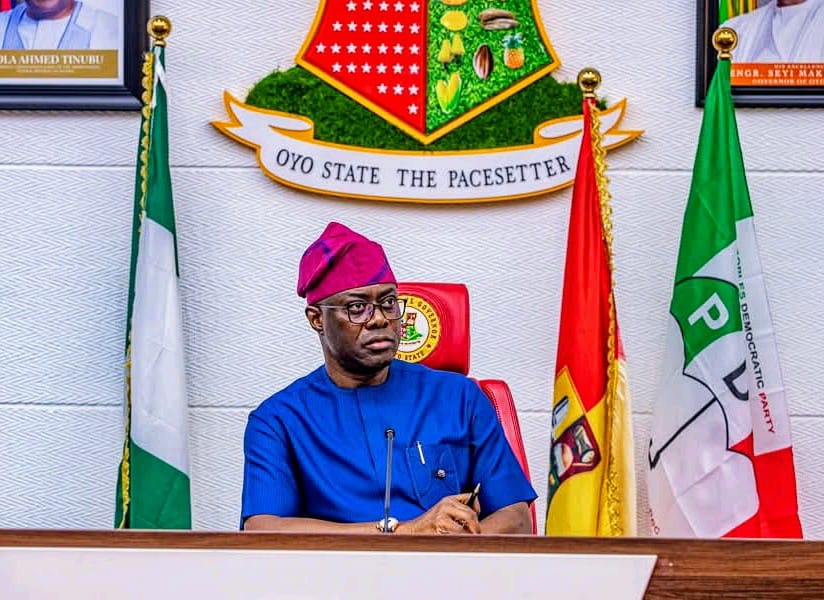
There is a reason Governor Seyi Makinde continues to attract unusually intense opposition from sections of Oyo State’s political establishment.
It is not merely about roads or elections, and it is certainly not just about the personality of the governor.
At the very core of the contest is something even deeper: who should control power in Oyo State — the traditional political class or the people?
For years, politics in the state, as in many parts of Nigeria, was largely organised around powerful individuals, political structures and networks of influence.
Access to government could depend on who one knew, which camp one belonged to and whose political interest one represented.
Makinde arrived with a different proposition and presented himself as a governor who would rather build institutions than political empires, pursue development than manufacture political enemies, and allow the electorate to determine political outcomes rather than permit a handful of powerful actors to decide who gets what.
That disruption has consequences and that explains why some opposition elements appear to dislike him so intensely and have continued the gang up agenda against him, because to them, politics is the main shop.
In that sense, they may be ‘right’ to hate what Makinde represents, because his politics has challenged the old arrangement in which political power was treated as the property of the political class. I mean, that is understandably why most of them play it as a do-or-die affair.
Makinde has attempted to return that power to the electorate and nowhere is that transformation more visible than on the road infrastructure that now connect every single zone together into a single ‘community’.
For decades, travelling across Oyo State was far more than a journey. It was often an endurance and resilience test.
Communities were separated not only by kilometres but by broken roads, failed infrastructure and difficult terrain. A journey from one part of the state to another could become an expensive undertaking.
Farmers struggled to move their produce. Traders lost time and money. Students endured long commutes while sick people faced difficult journeys to hospitals.
The consequences went beyond inconvenience because poor connectivity helped reinforce the inequality that only benefits the political class.
A community with no good road remained economically distant from the rest of the state. A farmer could produce food but struggle to get it to the market. A trader could identify an opportunity in another town but be discouraged by transportation costs.
Across Oke-Ogun, Ogbomoso, Oyo and Ibarapa, major roads have either been constructed, rehabilitated, completed or placed within the government’s infrastructure plans.
The objective is quite bigger than asphalt to even say the least. It is about making Oyo State function as one economic space, or simply put more simply, turning the state into one big “village”, where Ibadan is no longer a world away from Iseyin, Ogbomoso is no longer isolated from Oke-Ogun, and Ibarapa is no longer treated as a distant corner of the state.
Infrastructure determines who gets connected to opportunity. When a road reaches a community, government becomes more tangible. Markets become accessible. Businesses move in. Public servants can reach their assignments. Emergency services become easier to deploy and armers gain access to larger markets.
In other words, infrastructure gives ordinary people a greater stake in the overall economy.
That is precisely why Makinde’s development model has political implications that is currently endearing him to the endless attacks by those whose political relevance is daily dwindling and others who are becoming politically irrelevant.
The governor has repeatedly framed his administration around the idea of strengthening institutions rather than building a political structure around one individual.
Whether one supports him politically or not, there is little doubt that his administration has attempted to make development visible across geographical boundaries and that has created an uncomfortable question for the old political establishment.
The questions are simply: what happens when voters begin to judge politicians by what they can see, touch and use rather than by political endorsements ans media propaganda?
What happens when a road becomes more persuasive than a political slogan?
What happens when a farmer cares more about getting his produce to market than about which political godfather controls a local structure? And that is where the real political battle lies.
Few projects capture this philosophy better than the 76.7-kilometre Iseyin–Fapote–Ogbomoso Road, commissioned by Makinde on May 30, 2024.
Renamed the Adebayo Alao-Akala Memorial Highway, the road provides an important connection between Oke-Ogun and Ogbomoso.
For years, the absence of a dependable direct connection limited movement between the two geopolitical zones but that they say, is history today.
Now, the equation is changing. Farmers in Oke-Ogun have another route towards markets. Traders from Ogbomoso can reach communities in the agricultural belt more easily. Transporters have a more direct corridor, while residents can travel between the two zones with greater convenience.
The project demonstrates what happens when government looks at the state as one geographical and economic entity rather than as a collection of political constituencies.
A road does not ask whether a traveller voted PDP, APC, APM or any other party. It simply serves the traveller, and that is the essence of public infrastructure. Connecting Ibadan the state capital to Oke-Ogun and all other regions.
The 65-kilometre Moniya–Ijaiye–Iseyin Road, commissioned in 2021, provides another important link between the state capital and the food basket of the state.
The one hour distance journey on the road which was before Makinde’s administration a four hours trip now connects Ibadan with Oke-Ogun, bringing the state capital closer to one of its most agriculturally significant regions.
For years, Oke-Ogun’s agricultural strength has been obvious. The missing ingredient was often bad road connectivity and the economy of the state has also suffered for it.
A farmer can cultivate acres of land, but if transporting the harvest to market is prohibitively expensive, the economic value of that production is reduced while they reduce travel difficulties and help connect producers with consumers.
The road therefore represents more than a route between Moniya and Iseyin.
It represents an attempt to connect the administrative centre with the agricultural heartland.
Oyo, with its historic importance, and Iseyin, with its commercial and agricultural significance, are increasingly connected by a more functional road network, and the significance of such a connection extends beyond the communities immediately located along the route.
A road from A to B becomes economically powerful when it connects with roads from B to C, C to D and D back towards major markets. That is how isolated communities become part of a larger economy, and that is precisely the pattern emerging across Oyo State.
The Saki–Ogbooro–Igboho Road, measuring about 45.3 kilometres, is another major link in the western corridor. The road connects communities in Saki West, Saki East and Oorelope.
Saki is a major commercial centre. Igboho is an important agricultural and trading community. Ogbooro and surrounding settlements are home to thousands of residents whose economic lives depend on movement.
When these communities are better connected, the benefits travel with the road: goods move, people move, ideas move, and nvestment becomes easier.
And opportunities that once seemed far away become reachable.
The Ogbomoso–INEC–Atunleketa–Iresaadu Road, the Ogbomoso–Igbeti corridor and several township roads have included in government infrastructure and road-maintenance records.
This is important because major highways alone cannot transform a city.
A highway can bring a visitor into Ogbomoso, but internal roads determine whether that visitor can move efficiently within the city.
Township roads connect markets to residential areas, schools to communities and neighbourhoods to major highways. They are the arteries beneath the headline projects.
The 48-kilometre Ido–Eruwa Road is designed to strengthen the connection between Ibadan and Ibarapa, while other routes around Eruwa, Lanlate, Maya and Igboora have featured in the state’s road infrastructure and maintenance plans.
The Igboora–Igangan–Iganna Road also provides a link between parts of Ibarapa and Oke-Ogun.
These may not generate the same headlines as a major urban expressway but for ordinary non partisan residents, their importance can be enormous for their daily lives and businesses.
The quiet revolution on smaller roads
Perhaps one of the least appreciated aspects of the administration’s infrastructure programme is the network of smaller roads recorded by the Oyo State Road Maintenance Agency.
Roads in communities around Saki, Ogbomoso, Igbeti, Kishi, Okeho, Ago-Are, Ofiki, Eruwa, Lanlate and Maya may not make national headlines but these are the roads people use every day.
They are the roads leading to homes, markets, schools, farms and places of worship. These are the roads that determine whether a community feels connected or abandoned.
And when hundreds of such connections are improved, the cumulative effect can be enormous economically.
This is where the Makinde phenomenon becomes politically interesting. The traditional political class thrives when political influence is concentrated.
A powerful political structure can determine who gets access, who receives attention and who becomes politically relevant but infrastructure changes that relationship.
When government projects become geographically widespread and citizens begin to see tangible development in their communities, political conversations can shift from individuals to institutions.
The voter begins asking different questions, not: “Who is your godfather?” but: “What have you done?”
Not: “Which political camp do you belong to?” but: “Where is the road?”
That is a dangerous transition for any political establishment that has depended heavily on influence networks. And this may clearly explain some of the hostility directed at Makinde.
The real threat is not necessarily Seyi Makinde the individual. The threat, for some elements of the old order, is the possibility that citizens may discover that political power belongs to them.
Makinde’s most consequential political achievement may therefore not be any single road. It may be the gradual change in the relationship between government and citizen.
When a government builds a road in a remote community, it sends a message:
“You matter.”
When it connects an agricultural zone to a major market, it says: “Your economic activity matters.” When it links communities across political boundaries, it says: “This state belongs to all of us.”
That is what returning power to the people should mean in practical terms, not simply allowing citizens to vote every four years, but ensuring that public resources translate into public value.
The opposition has every democratic right to criticise Makinde. Of course, that is democracy.
But if what irritates sections of the political establishment is the weakening of the old culture of political ownership, where a few people could determine the direction of an entire state, then the criticism may actually be evidence that something fundamental has changed.
The deeper story of the roads is therefore not about kilometres. It is about boundaries disappearing among initially disconnected regions.
The road from Ibadan to Iseyin reduces the distance between the capital and Oke-Ogun. The Iseyin–Fapote–Ogbomoso corridor reduces the distance between Oke-Ogun and Ogbomoso. The Oyo–Iseyin road strengthens the connection between the ancient Oyo axis and the agricultural belt. The Saki–Ogbooro–Igboho route strengthens the western corridor. The Ido–Eruwa and other Ibarapa links pull that zone closer to the rest of the state.
Piece by piece, the old geography of separation is giving way to a geography of connection.
There is something powerful about being able to travel from one end of a state to another without feeling that you have crossed into a completely different world.
Makinde may not have literally turned Oyo State into a village but his road network is making the state feel smaller.
And that may ultimately be the most important political story behind the concrete, asphalt and bridges.
A government that connects its people also makes it harder for a few people to monopolise access to power.
That is why the fiercest opposition to Makinde may not always be about roads, budgets or policies. It may be about what those roads represent.
They represent a state in which citizens can move more freely, trade more widely, demand more from government and increasingly judge politicians by performance.
They represent a gradual transfer of political conversation from the corridors of the powerful to the streets of the people.
And if that is what truly unsettles parts of the old political class, then their anger is understandable because Makinde’s most disruptive project may not be any particular highway.
It may be the attempt to make the people themselves the final owners of political power.