

If anything, history has shown that Nigerian politics always has a way of circling back on itself. Just when things begin to look settled, a new alignment starts to form and old rivals begin to sit at the same table.
Familiar arguments then return, but only this time, with a sense of urgency that feels a little sharper and a little more desperate. That is where things stand as 2027 approaches in full speed.
Across the opposition, there is a growing recognition that something has to give way for a path to the table. The language is about unity, strategy, and survival. And if it all sounds familiar, that is because the country has heard it before, in the years leading up to the birth of the All Progressives Congress (APC).
But history does not always repeat itself in neat, predictable ways. Sometimes it only does in rhymes.
To make sense of what is happening now, it helps to go back to 2013, when the then opposition stopped pretending it could win alone.
At the time, the Peoples Democratic Party (PDP) was not just the ruling party, it was the system. Since 1999, it had built a grip on power that felt almost immovable.
Opposition parties existed, but they were scattered, regional, and often more invested in protecting their strongholds than winning nationally.
There were three serious blocs and these were: the Action Congress of Nigeria (ACN) in the South-West, the Congress for Progressive Change (CPC), anchored by late former President Muhammadu Buhari’s following in the North, and the All Nigeria Peoples Party (ANPP), with a wider but thinning presence.
They had all tried, and they had all lost. By the time Goodluck Jonathan won in 2011, the lesson was no longer theoretical. It was blunt and unavoidable. The fact then remained that divided, they were not contenders, they were spectators.
What followed was not an easy coming together. It was messy, tense, and filled with suspicion. But eventually, something shifted and gave way. These parties agreed to dissolve themselves into a new political home, the APC.
That decision mattered. It forced everyone into one structure, one set of rules, one internal contest. It did not eliminate ambition, but it contained it.
Then came the reinforcements. A faction of the PDP broke away, bringing with it sitting governors and heavyweights like Atiku Abubakar. Suddenly, the opposition was no longer just loud. It was viable.
By 2015, with the late Muhammadu Buhari as its candidate, the coalition did what had once seemed unlikely. It defeated an incumbent and power for the first time since 1999, changed hands from the ruling party to the then opposition.
Yes! it worked, not because everyone agreed, but because enough people were willing to give up something historically personal. The rest story today, is history.
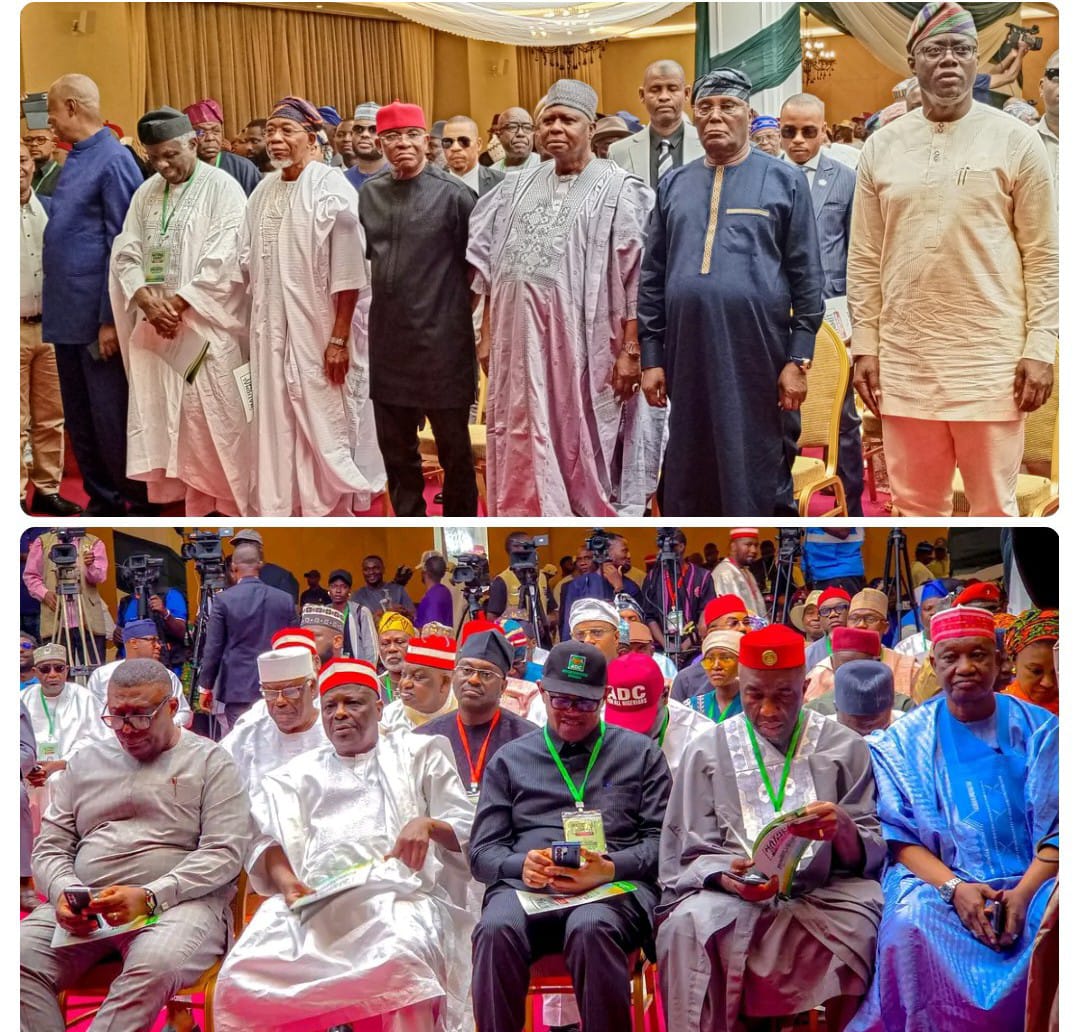
Fast forward to April 2026. In Ibadan, the Oyo State capital, opposition leaders gathered again with different setting but similar stakes.
Around the table were familiar names. Atiku Abubakar. Peter Obi. Rabiu Musa Kwankwaso. Rotimi Amaechi. Rauf Aregbesola and a new name in the mix, governor Seyi Makinde.
They came from different parties. The PDP. Labour. NNPP. And the African Democratic Congress (ADC), among others.
The message they tried to send was simple enough. This time, they would not split the vote. This time, they would try to agree on a single presidential candidate to face the APC.
On paper, it makes perfect sense. The ruling party has the advantage of incumbency, structure, and reach. The opposition has numbers, but those numbers are scattered.
So the thinking is straightforward. Bring the numbers together, and you have a contest.
But politics rarely follows clean logic.
Alliance is not the same thing as merger and here is where things begin to get complicated for the opposition leaders.
In 2013, parties did not just cooperate. They outrightly merged and collapsed their different political structures into one.
They gave up their separate identities and created something new. That forced difficult decisions early.
What is happening now is different however, because parties are talking about working together, but not about becoming one. Everyone is still holding on to their platform, their structure, their loyalists.
It sounds flexible. In reality, it leaves the hardest question hanging in the air.
Who steps aside, and for who?
Because that is what a single candidate requires. Not just agreement in principle, but sacrifice in practice.
And almost immediately, the strain began to show. Some factions within the parties started to distance themselves.
Quietly at first, then more openly. The kind of hesitation that suggests the idea of unity is easier to announce than to enforce.
At the same time, another layer of uncertainty crept in. Reports began to circulate about movements by key figures like Rabiu Musa Kwankwaso and Peter Obi toward alternative political platforms.
Whether those moves are tactical or strategic, they send a clear signal. Even among those pushing for unity, there is still a search for leverage, for positioning, for a platform that offers control as much as opportunity.
In the middle of all this, the African Democratic Congress (ADC) has taken on an interesting role.
It is not the biggest party in the room, but that may be its advantage. It carries less baggage, fewer entrenched rivalries. It can present itself as neutral ground, a place where competing interests might meet without feeling overshadowed.
That idea has its appeal. But neutrality has limits.
A platform can bring people together, but it cannot, on its own, make them agree.
And if major players are already exploring different political homes, the idea of gathering everyone under one roof starts to feel less certain.
Instead of convergence, you begin to see parallel tracks forming. Each one viable enough to matter, but not strong enough to settle the contest.
There is something attractive about the phrase “consensus candidate.” It suggests clarity. A moment where everyone agrees, steps back, and rallies behind one person.
But that kind of agreement rarely happens naturally. It is usually negotiated, sometimes forced, and often fragile.
In 2013, consensus held because it was backed by a structure that could absorb disagreement. There were rules. There was a system. There was a single party to hold it all together.
Today, that structure does not exist. What exists instead is a series of conversations, layered with ambition.
And now, with leading figures reportedly testing different political paths, the idea of consensus begins to feel less like a destination and more like a bargaining position.
Something to aim for, but also something to negotiate around.
The risks are not hard to see:
Strong contenders who believe it is their turn, regional expectations that cannot be easily ignored, party loyalists unwilling to be folded into another structure, last-minute shifts if agreements fall apart, and now, early movements that hint at alternative plans
What looks like unity from a distance can, up close, feel like a temporary truce.
There is no question that opposition leaders understand the stakes. The memory of 2015 still lingers. They know what is possible when forces align.
But understanding is one thing repeating it is another and that is where it is believed that the opposition leaders miscalculated in their approach even though the idea of a single front was lofty.
The APC did not emerge from polite agreement. It was built through concessions that were, at the time, uncomfortable and, for some, costly.
That moment has not quite arrived in the current cycle. If anything, the signs suggest that many of the key players are still weighing options, keeping doors open, and holding back from irreversible decisions.
As 2027 draws closer, the political talks surely will get louder. There will be more series of meetings, more declarations, more attempts to project unity.
But eventually, the process will demand something more concrete; a name and viable platform.
A decision that not everyone will like but
until then, the idea of a single opposition candidate will continue to hover somewhere between strategy and aspiration, still a little distant from actionable reality.
It makes sense on paper. It answers a real political need but in the shifting, complicated reality of Nigerian politics, it may yet prove to be what it currently feels like, and that is a compelling idea, a necessary gamble, and perhaps, just perhaps, an illusion waiting to meet the test of ambition.