

Like the first distant rumble before a heavy tropical storm breaks across the sky, the political atmosphere in Oyo State is already charged ahead of the 2027 governorship election.
Beneath the calm language of official declarations and carefully managed public appearances, rival camps are quietly sharpening swords, rebuilding alliances and studying old political battle maps in preparation for another fierce struggle for Agodi Government House.
To many seasoned political observers, what is unfolding does not entirely feel like a new story. It feels more like an old masquerade returning to the village square in a different costume.
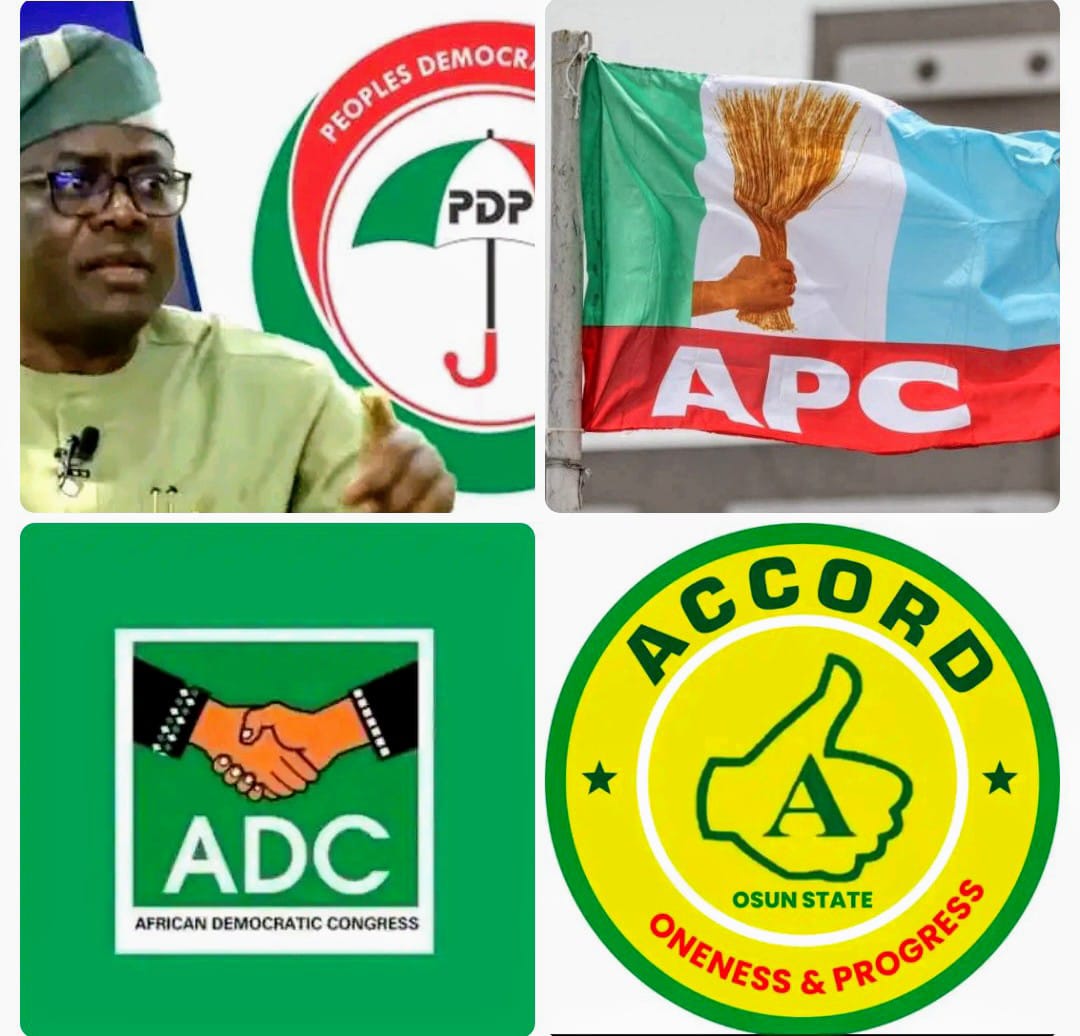
The political chessboard is once again arranging itself into what increasingly resembles the same four-horse race that shaped the historic 2015 governorship election and permanently altered Oyo’s political direction.
Back then, four powerful rivers flowed against one another: the All Progressives Congress (APC), Peoples Democratic Party (PDP), Accord Party and the Social Democratic Party (SDP).
Their collision produced one of the fiercest electoral contests in the state’s democratic history. Today, history appears to be knocking once again at Oyo’s political gate, only this time the actors have exchanged positions on the stage.
The SDP of yesterday is gradually being replaced by the rising African Democratic Congress (ADC), while Accord Party still lingers like an ageing political war drum whose sound may no longer shake the forest, but still commands attention whenever it roars.
The ruling PDP now occupies the commanding heights once held by APC in 2015, while the APC itself has returned to the trenches of opposition politics searching for a pathway back to power.
For many political analysts across the state, the similarities between both eras are becoming too striking to dismiss as coincidence.
The same ingredients that shaped the 2015 outcome are quietly gathering again: fragmented opposition forces, restless political gladiators, coalition whispers, regional calculations, succession intrigues and an incumbent structure hoping to benefit from division among its challengers.
The 2015 governorship election remains one of the deepest footprints ever stamped on the sands of Oyo politics.
At the centre of that political hurricane was the late former governor, Abiola Ajimobi, who battled not one enemy, but several ambitious hunters determined to bring down the lion of the moment.
Conventional wisdom at the time suggested that the swelling anger against the incumbent administration would sweep APC out of power.
Yet politics, like the weather, often obeys strange winds. While opposition forces marched with drums of resistance, they approached the battlefield through different paths, splitting their strength and scattering their firepower across the state.
The PDP sought to reclaim lost dominance. Accord Party, under the influence of former governor Rasheed Ladoja, remained a stubborn political mountain in Ibadan politics.
SDP emerged as a refuge for displaced political warriors unwilling to bow before either APC or PDP. Instead of forming one mighty river against the incumbent, the opposition dissolved into competing streams.
Ajimobi understood the arithmetic of divided resistance. Like a skilful chess master watching opponents fight among themselves, he held together enough of his political fortress while rival camps weakened one another.
When the dust finally settled, APC survived the storm, and Ajimobi carved his name into history as the first governor in Oyo State to win two consecutive terms since Nigeria’s return to democratic rule in 1999.
That election planted a permanent lesson in Oyo’s political soil: in a fragmented battlefield, the incumbent often becomes the unexpected beneficiary.
Now, as 2027 slowly rises on the horizon like dawn after a restless night, the silent sound of 2015 are becoming impossible to ignore.
Once again, the political marketplace is crowded with competing traders shouting different promises to the electorate.
Once again, alliances are shifting like desert sand beneath the feet of ambitious politicians.
Once again, whispers of defections and coalition arrangements drift through the corridors of power like smoke searching for dry grass on daily basis but only this time, the political masquerades have exchanged costumes.
In 2015, APC stood as the ruling establishment defending power. In 2027, it is the PDP under Governor Seyi Makinde attempting to protect the throne after nearly eight years in office.
Ironically, the same political weather that once favoured APC may now be preparing shelter for the PDP.
Makinde today stands at the centre of Oyo’s political universe like a giant iroko tree casting shadows across the forest.
Since assuming office in 2019, he has steadily woven a political net stretching from urban elites to grassroots communities.
Through infrastructure projects, welfare initiatives, local government influence and the powerful “Omituntun” identity, the governor has built something larger than ordinary party loyalty.
In many parts of the state, loyalty to Makinde now appears stronger than loyalty to PDP itself. Makinde is gradually transcending the limit of ordinary human identity into a political institution itself.
The several reaffirmation of loyalty by PDP faithful to Makinde readily validates this position and it may not be long before political actors in the state come to term with the fact that Makinde’s name has grown into something bigger than just an identity.
That reality explains why rumours surrounding possible coalition movements involving ADC have generated unusual political anxiety.
Several loyalists within the ruling structure have openly suggested they would follow the governor wherever he chooses to pitch his political tent ahead of 2027.
Such declarations reveal a deeper truth about Oyo politics: parties may provide the vehicle, but powerful personalities often control the steering wheel.
Yet, beneath the polished surface of the ruling camp, silent battles are already unfolding.
Ambitious aspirants from Ibadan, Ogbomoso, Oke-Ogun and Oyo zones are circling the succession battlefield like eagles searching for favourable winds.
Meetings are being held behind closed doors. Political calculations are unfolding in whispers rather than public speeches.
Every denial of endorsement only seems to strengthen speculation that the succession struggle has already begun long before official campaigns.
Still, despite the growing tension within the PDP, the party continues to enjoy one dangerous advantage: its challengers remain divided.
And division, in politics, can be more destructive than outright weakness.
The APC, though energised by federal power under President Bola Tinubu, still resembles a house struggling to rebuild its pillars after a powerful earthquake.
Since the death of Ajimobi, the party has wandered through internal disagreements, leadership disputes and competing ambitions without finding a single commanding voice capable of uniting all factions.
Old loyalists, younger technocrats, federal appointees and regional blocs continue to pull the party in different directions like stubborn horses tied to one chariot.
Yet the APC cannot be dismissed lightly.
Oyo remains politically unpredictable terrain where governments rise and fall like tides.
The party still possesses federal influence, national visibility and significant grassroots support across several zones.
More importantly, APC leaders understand that if the PDP succession process explodes into open conflict, frustrated political heavyweights could migrate into opposition ranks and alter the electoral equation overnight.
But the APC’s greatest obstacle may not be defeating PDP. Its greatest challenge may be defeating the ghosts inside its own walls.
Then comes the ADC, emerging quietly like a new drumbeat from a distant corner of the political arena.
Ordinarily, ADC would have remained a minor spectator in Oyo politics. But national coalition conversations and growing speculation surrounding elite political realignments have suddenly transformed the party into a rising wildcard.
Like SDP in 2015, ADC is gradually becoming a political shelter for dissatisfied actors searching for an alternative route to power.
Its present strength does not necessarily lie in grassroots machinery. Rather, its growing relevance lies in its potential to become a coalition vessel carrying displaced political interests from larger parties.
And in Nigerian politics, structures can migrate faster than ideology.
If influential camps within PDP or APC eventually collapse into ADC ahead of 2027, the party could evolve from a fringe movement into a major electoral force almost overnight.
That possibility alone has changed political calculations across Oyo.
Meanwhile, Accord Party remains like an ageing warrior whose sword may no longer glitter as brightly as before, but whose name still carries echoes of old political battles.
Though diminished from its glorious years under former governor Ladoja now the Olubadan of Ibadan, the party still retains symbolic influence within parts of Ibadan politics and among older loyalists tied to its legacy.
In fragmented elections, even smaller parties can become dangerous spoilers capable of splitting votes, negotiating alliances or shaping local outcomes.
It may become true again in 2027. Indeed, the biggest resemblance between both political eras lies in the dangerous multiplication of strong political platforms.
History repeatedly shows that fragmented opposition landscapes often become fertile soil for incumbents.
While challengers waste energy competing against one another, the ruling structure quietly consolidates its machinery, strengthens grassroots networks and maximises institutional advantage.
That formula worked in favour of APC in 2015. It may now work again in favour of PDP in 2027.
At the core of everything going on now in the state stands the Makinde succession question.
Can the governor successfully transfer political authority without the need for political alliance with smaller parties? That may ultimately become the defining question of the election.
Ajimobi survived in 2015 because he maintained enough internal cohesion while opposition camps fragmented around him.
Makinde now faces a similar test. If he successfully manages succession and keeps his structure united, the ruling camp may remain extremely difficult to defeat regardless of party platform.
But if ambition erupts into rebellion, the political earthquake that follows could shake every party structure in the state.
Still, one enduring truth about Oyo politics remains unchanged, and that is the fact that voters in the state rarely surrender themselves permanently to any party.
Oyo’s electorate mostly behaves like restless travellers constantly searching for the next convincing destination, and Makinde must bear that strongly in mind if he is ready to play the game for victory.
Governments have risen and fallen across PDP, APC, and coalition-backed movements because voters often place greater value on personalities, regional balancing and political momentum than rigid ideological loyalty.
That unpredictability is what makes the unfolding 2027 contest both dangerous and fascinating.
As the political drums grow louder and rival camps continue sharpening their weapons for battle, Oyo once again, is standing at the edge of another historic crossroads.
Once again, the state appears headed toward a four-horse race involving PDP, APC, ADC and Accord Party. Once again, coalition whispers and elite fragmentation dominate the political atmosphere. Once again, the incumbent structure may benefit from opposition disunity.
Bear in mind that in 2015, those conditions delivered victory to APC and Ajimobi.
In 2027, the same political currents may now carry PDP and Makinde’s succession project toward survival.
But politics has never been a river that flows in only one direction.
And in Oyo State, where power changes hands like a wandering crown searching for its next king, history may repeat itself, or suddenly rewrite itself in an entirely different language.