

Nigerian politics is once again entering that familiar season when ambition begins to move quietly beneath handshakes, smiles become strategic, alliances suddenly emerge from old rivalries, and every political gathering carries the scent of future power.
Ahead of 2027, the opposition landscape resembles a vast political marketplace where calculations are being traded like commodities.
Beneath the public speeches about unity and national rescue lies a deeper struggle for relevance, survival, influence, and ultimately, control of the Nigerian state.
The Ibadan Declaration, the push for a single opposition presidential candidate, the Obi-Kwankwaso movement into the NDC, and Governor Seyi Makinde’s carefully crafted PDP-APM alliance are not isolated political events. They are pieces of a much larger puzzle unfolding before the country’s eyes.
Together, they reveal a political class attempting to build a bridge while already standing inside a storm.
When opposition leaders gathered in Ibadan to discuss coalition politics and a possible single presidential candidate, the message was clear even before microphones were switched on.
They understood what happened in 2023.
The APC did not merely win because it was unbeatable. The opposition lost partly because it approached the battlefield carrying different flags, different ambitions, and different egos.
In many ways, the Ibadan Declaration was born from political regret.
It was an admission that Nigeria’s opposition forces entered the last election like hunters chasing the same animal while shooting in different directions.
By the time the dust settled, Bola Tinubu and the APC walked away with victory while opposition votes remained scattered across multiple camps.
The dream of a united opposition therefore sounded attractive. On paper, it looked almost irresistible.
Combine Atiku’s northern establishment structure, Obi’s youth-driven urban movement, Kwankwaso’s northern populist machinery, Makinde’s Southwest influence, and perhaps a few other regional blocs, and suddenly APC begins to look vulnerable.
But Nigerian politics has never been a mathematics class. It behaves more like a crowded marketplace where emotion, suspicion, ambition, tribe, religion, ego, and survival all shout at the same time.
The real challenge was never whether opposition leaders agreed APC should be challenged.
The real challenge was deciding who would sit at the head of the table when power finally arrived. That was where the beautiful dream began to crack.
The eventual movement of Peter Obi and Rabiu Musa Kwankwaso into the NDC did not merely weaken the original coalition arrangement.
It exposed the oldest truth in Nigerian opposition politics: everybody wants unity until the conversation turns to leadership.
Peter Obi and Kwankwaso are not ordinary politicians anymore. They now represent emotional political movements with devoted followers who see them almost as symbols rather than mere candidates.
Obi’s Obidient movement is perhaps the closest Nigeria has come in recent years to a political uprising driven by hope, frustration, and generational anger.
It is powered by young Nigerians tired of recycled promises, urban professionals exhausted by economic decline, and millions of southeastern supporters who saw Obi’s candidacy as both political participation and cultural validation.
For many supporters, Obi became more than a politician. He became a protest wrapped inside a presidential campaign.
Kwankwaso, on the other hand, commands something equally powerful in the North.
The Kwankwasiyya movement is not simply a party structure. It is a political tribe held together by loyalty, symbolism, and emotional memory. The famous red cap is not ordinary clothing. It is a political uniform stitched together with identity and belonging.
In the North, and Kano especially, Kwankwaso’s influence behaves almost like inherited loyalty. Even when parties change, followers remain.
Bringing Obi and Kwankwaso together therefore looked politically brilliant. It appeared like the joining of two powerful rivers from opposite ends of Nigeria.
But rivers do not merge easily when each believes it should determine the direction of the current.
Obi remains strongest among urban youths, southeastern voters, Christians, and educated middle-class Nigerians. Kwankwaso’s fortress lies within Kano and parts of the Northwest where grassroots populism still outweighs social media excitement.
Together, they create national conversation. Whether they can create national victory remains another question entirely.
Before 2023, many Nigerians believed only the APC or PDP could seriously compete for presidential power.
Peter Obi shattered that assumption like a stone thrown through an old political window.
Almost overnight, Labour Party transformed from a marginal political platform into a nationwide movement.
The Obidient wave moved through social media, universities, churches, professional circles, diaspora communities, and urban centres with unusual speed.
What made Obi particularly dangerous politically was not just his support in the Southeast. It was the spread of the Igbo population across Nigeria’s economic nerve centres.
The Igbo trader in Lagos, the businessman in Kano, the spare parts dealer in Abuja, the market woman in Port Harcourt, the student in Jos, the entrepreneur in Benin, all became part of a wider political network.
For the first time in years, many Igbos across Nigeria felt politically synchronized behind one presidential project.
That energy translated into real votes.
Obi’s victory in Lagos was not merely an electoral upset. It was symbolic rebellion inside the political cathedral of Bola Tinubu.
It sent shockwaves through the establishment because Lagos was never supposed to fall.
Yet the election also exposed the harsh limitations of online enthusiasm in Nigerian politics.
Hashtags do not protect ballot boxes.
Digital excitement alone cannot replace ward structures, local agents, polling-unit coordinators, transport mobilizers, and election-day machinery.
The Obidient movement changed political conversation in Nigeria forever. But 2023 also reminded everybody that elections are not won only on screens, they are won on the ground.
If Obi represents Nigeria’s urban political awakening, Kwankwaso represents the enduring power of northern grassroots populism.
Kwankwasiyya is one of the few political movements in Nigeria that still feels organic. Its followers are emotionally invested, fiercely loyal, and deeply connected to its symbolism.
In Kano, Kwankwaso does not merely campaign. He commands political devotion.
The movement feeds on memories of empowerment, educational opportunities, and populist identity.
Among supporters, Kwankwaso is often viewed as a leader who speaks the language of ordinary northern people rather than elite Abuja politics.
This is why every opposition coalition wants him close. Without serious northern penetration, no presidential candidate can realistically enter Aso Rock.
Yet Kwankwasiyya also faces a difficult reality. Outside Kano and parts of the Northwest, its influence weakens considerably. Like many personality-driven movements in Nigeria, it shines brightest around its founder. Its future beyond Kwankwaso himself remains uncertain.
Perhaps the most delicate political dance unfolding today belongs to Governor Seyi Makinde.
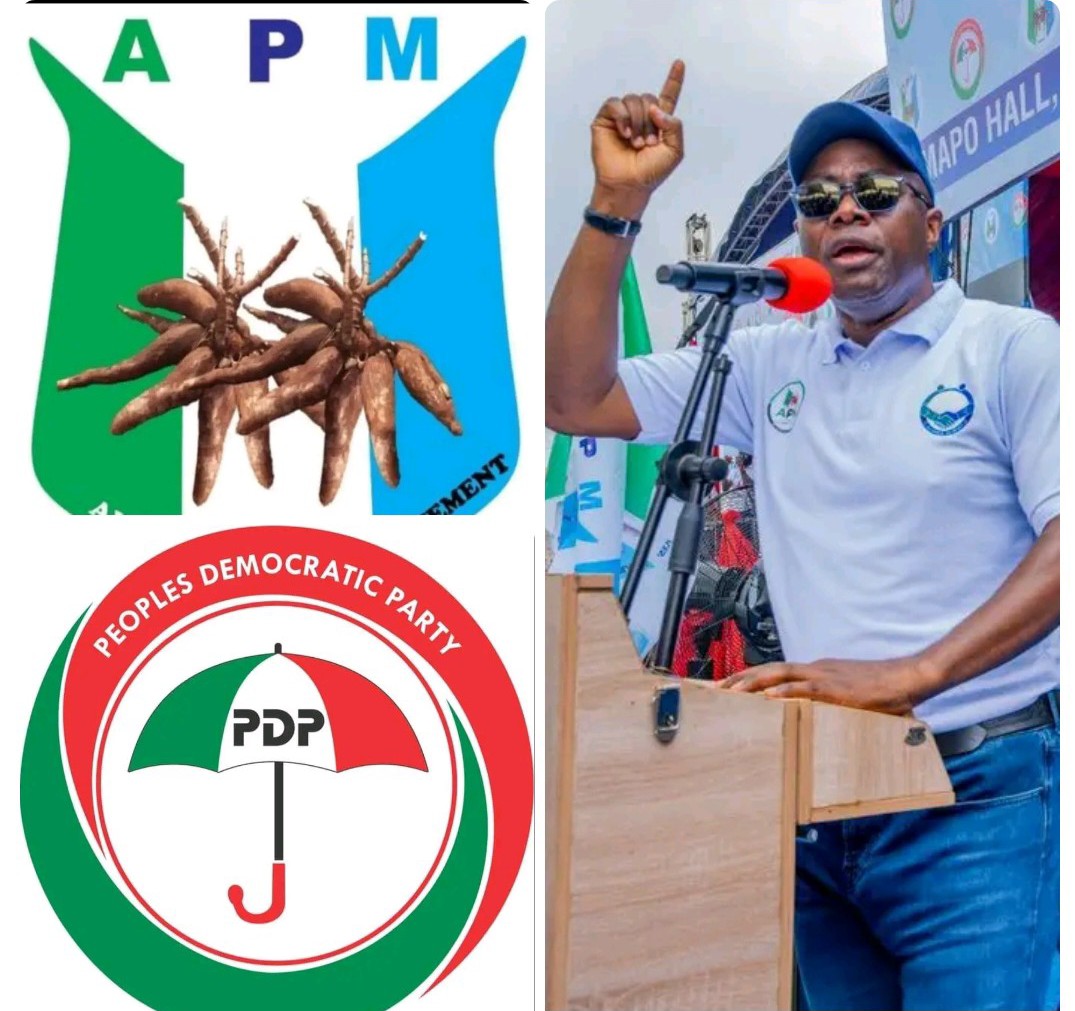
His adoption of a grand alliance carrying the “PDP-APM” inscription instead of fully declaring for APM reflects a politician walking on a tightrope while balancing two heavy baskets at once.
Makinde appears to understand something many elite politicians often ignore: Nigerian voters do not always follow elite political calculations.
Many voters still recognize politics through symbols, emotions, familiarity, and long-standing party attachment.
The PDP umbrella remains one of the most recognizable political symbols in Nigeria. In many rural communities, voters may not understand coalition theories or internal party crises, but they recognize familiar logos instantly, and Makinde knows this.
That is likely why he has refused to completely abandon PDP identity while simultaneously building APM structures quietly beneath the surface.
The PDP-APM arrangement resembles a man gradually moving his belongings into a new house while still sleeping occasionally in the old one.
Strategically, it can be agreed upon to be brilliant but electorally, it is dangerous.
One of Nigeria’s biggest democratic weaknesses remains poor voter education.
Many voters still struggle with ballot recognition, coalition understanding, and party differentiation. In rural areas especially, familiarity often defeats complexity.
This is where Makinde’s dual branding could become either genius or disaster.
The politically informed elite may understand the strategic meaning behind PDP-APM. But the average rural voter may simply ask: “Which logo are we voting for?”
And in Nigerian elections, that question matters enormously, and it can not be trivialized for momentary convenience and political aggrandizement.
A confused voter is like a traveller entering a crowded market without direction. Eventually, he follows the loudest voice or the most familiar face.
If voters are not carefully educated ahead of 2027, coalition ambiguity could create dangerous confusion at polling units. Some may vote wrongly.
Others may become frustrated. Some may simply retreat to familiar party symbols.
This becomes even more critical because elite voter apathy remains a recurring Nigerian problem.
Ironically, the most politically vocal citizens are often the least reliable on election day.
Urban elites dominate online conversations, organize political debates, and speak passionately about national reform, yet many of them fail to physically vote or even show up on election day.
Meanwhile, rural political structures and people in the informal sectors, the market women, traders and artisans, religious and sociocultural groups, remain disciplined, organized, and emotionally connected to local mobilizers.
That reality means simplicity matters.
Elections are rarely won through intellectual sophistication alone. They are won through clarity, familiarity, and emotional certainty.
Beneath all these developments are still a deeper crisis eating slowly at Nigerian democracy and that is the fact that Political parties are becoming increasingly weightless.
Ideology has weakened, institutional identity has faded, loyalty now revolves around powerful individuals rather than party principles or the institution.
Politicians move from PDP to APC, from APC to ADC, from LP to coalition platforms, from coalition platforms into fresh alliances, often carrying supporters with them like travelling caravans.
Parties increasingly resemble buses at a crowded motor park. Politicians board whichever vehicle appears most likely to reach power.
Makinde’s PDP-APM strategy reflects this larger reality. It is both politically intelligent and institutionally troubling.
It shows how survival now dominates Nigerian politics more than ideological consistency.
As 2027 approaches, Nigeria’s opposition resembles musicians attempting to conduct an orchestra while each still wants to hold the conductor’s baton.
The Ibadan Declaration represented hope for unity, the Obi-Kwankwaso movement in NDC revealed the limits of compromise, and Makinde’s PDP-APM alliance reflects strategic caution in an unstable political environment.
Yet one truth stands above all calculations, and that is the fact that the opposition may possess talent, influence, emotional support, regional strength, and public frustration on its side, but unless these forces eventually speak with one clear political voice, APC may continue benefiting from the oldest weapon in politics: a divided opposition.
Because in the end, Nigerian elections are not won only by the strongest candidate.
Another danger lurking beneath Makinde’s PDP-APM alliance is the silent confusion that often destroys political structures from within long before election day arrives.
Politics, especially in Southwest Nigeria, thrives heavily on emotional clarity. Voters want to know where their leader truly stands.
They want a clear banner to wave, a familiar symbol to protect, and a definite political house to defend but the PDP-APM arrangement currently resembles a man standing with one leg inside two different boats drifting slowly apart on a turbulent river.
The longer that uncertainty continues, the greater the risk that ordinary voters may begin to lose emotional connection with the project itself.
And in politics, once emotional certainty begins to fade, loyalty starts leaking quietly like water from a cracked clay pot.
The danger becomes even more severe when succession politics enters the conversation. Installing a successor is often the most difficult political exam any governor faces because the election is no longer about the governor’s personal charisma alone.
It becomes a test of how effectively he can transfer trust, emotional goodwill, and political authority to another individual.
Bola Tinubu succeeded in Lagos because APC had already become a deeply rooted political identity beyond one election cycle.
But Makinde’s coalition structure still appears suspended between transition and uncertainty. If voters arrive at the polls still asking whether they are voting PDP or APM, the confusion may not hurt Makinde personally, but it could seriously weaken the inheritance pathway for whoever eventually emerges as his preferred successor.
More dangerously, opposition rivals could weaponize that ambiguity against him with brutal effectiveness. Nigerian politics is a theatre where perception often defeats policy.
Opponents may begin portraying the PDP-APM alliance as a political smokescreen designed to deceive voters rather than a sincere coalition built on ideological clarity.
They could frame the arrangement as evidence that Makinde himself lacks confidence in APM’s electoral strength.
In local markets, roadside discussions, religious gatherings, and grassroots political meetings, such narratives spread rapidly because simple accusations travel faster than complex explanations.
Before long, the alliance could begin to look less like strategic intelligence and more like political indecision wrapped in elite grammar.
The greatest threat, however, may emerge at the grassroots level where elections are truly won or lost. Ward leaders, local coordinators, transport mobilizers, community influencers, and polling-unit agents are the foot soldiers who carry elections on their backs under the scorching sun.
These actors survive politically through certainty and structure but when party identity becomes blurred, internal suspicion begins to grow like termites eating gradually through the pillars of a wooden house. Some loyal PDP members may simply just fear abandonment.
Others entering through APM may feel politically inferior within the arrangement. Over time, unresolved tension inside the coalition could weaken mobilization energy precisely when maximum grassroots discipline would be required to protect Makinde’s succession ambition.
Ultimately, elections in Nigeria are rarely intellectual contests. They are emotional battles fought with symbols, familiarity, repetition, and psychological simplicity.
The average voter does not study coalition documents or constitutional arrangements. He remembers only party logos, campaign songs, symbols, and what his community leaders repeatedly tell him.
That is why political clarity often becomes more powerful than political sophistication. If Makinde delays too long before establishing one unmistakable political identity for his succession project, he risks entering the 2027 battlefield carrying a message too complex for the emotional rhythm of grassroots Nigerian politics.
And history has shown repeatedly that when voters become confused, they usually retreat toward the most familiar shelter available to them and this is where his political opponents may harvest his hard labour.