

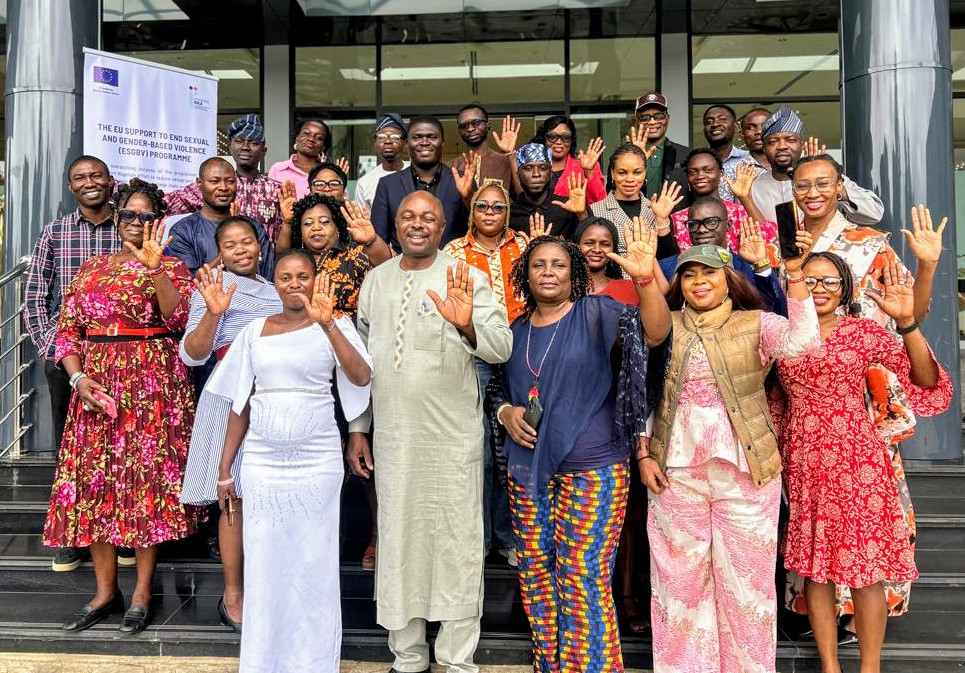
The European Union (EU), in collaboration with the National Agency for the Prohibition of Trafficking in Persons (NAPTIP) and the International Institute for Democracy and Electoral Assistance (International IDEA), has intensified efforts to combat Sexual and Gender-Based Violence (SGBV) in Nigeria through the training of media practitioners in Oyo State.
The two-day capacity-building workshop, organised under the EU Support to End Sexual and Gender-Based Violence (ESGBV) Programme and implemented by International IDEA, is aimed at strengthening the capacity of selected journalists towards the establishment of a dedicated SGBV Media Corps.
The initiative seeks to improve the quality, ethics and coordination of media and community-based communication on SGBV, while shifting reporting from sensationalist and fragmented coverage to professional, survivor-centred, evidence-based and action-oriented journalism.
The training is expected to produce a stronger and more coordinated corps of media practitioners capable of ethical, survivor-centred and evidence-informed reporting on SGBV and technology-facilitated SGBV.
Other expected outcomes include increased ethical and survivor-based reporting that promotes positive social norms; improved public awareness of SGBV reporting channels and support services; and increased implementation and enforcement of the VAPP Act through accountability and investigative journalism.
Participants, who were split into two for robust group discussion, also effectively engaged the Media Facilitator and Resource Persons based on their individual field experience on reporting SGBV.
Among key lecturers at the event were the Media Lead Facilitator and Resource Person for the training/workshop, Mrs. Toyin Adewale Gabriel and Mrs Wynyfred Achu-Egbuson, from Civil Society and Community Mobilisation Specialist ESGBV programm-International IDEA.
Declaring the training open, the Director-General of NAPTIP, Binta Lami Adamu Bello, whose speech was delivered by the agency’s Director of Media and Publicity, Vincent Adekoye, described the training as timely, stressing that the media remained a critical partner in the fight against sexual and gender-based violence.
Ms Bello commended journalists for their sustained support for NAPTIP, particularly through investigative reports, public education campaigns and efforts to expose hidden abuses.
She said the media was “not merely a channel for information,” but a partner in protection, prevention and justice, adding that responsible reporting had helped amplify the voices of survivors and galvanise public opinion and policy responses.
According to her, SGBV remains one of the most pervasive human rights violations in Nigeria, cutting across age, class, ethnicity and geography and affecting women, girls, boys and men.
She noted that the true scale of the problem was likely higher than available statistics suggested because many survivors still failed to report cases due to fear, stigma, lack of trust in society and economic dependence on perpetrators.
Ms Bello said the situation in Oyo State was equally concerning, with cases ranging from sexual assault and intimate partner violence to trafficking for sexual exploitation.
She identified the state’s youth-heavy population, increasing internet access and growing social media use as factors presenting both opportunities and vulnerabilities in the fight against SGBV. According to her, cultural norms, stigma and limited awareness of legal rights and available support services continued to prevent many survivors from speaking out or accessing justice.
Ms Bello said NAPTIP’s intervention was anchored on dignity, confidentiality and holistic care for survivors, adding that the agency’s mandate empowered it to investigate cases, rescue victims, provide medical and psychosocial support, facilitate legal assistance and pursue prosecution where appropriate.
The NAPTIP director-general said the agency had continued to implement the provisions of the Violence Against Persons (Prohibition) Act, 2015, resulting in increased prosecution and conviction of offenders. She, however, noted that NAPTIP had continued to restrategise in response to emerging trends in SGBV, particularly technology-facilitated abuse.
She identified non-consensual sharing of intimate images, sextortion, cyberstalking, grooming of minors, deepfakes used for humiliation and blackmail, and coordinated online harassment as emerging forms of technology-induced gender-based violence. She said such abuses could be instantaneous, far-reaching and capable of remaining online long after the initial incident.
To tackle the emerging threat, she said NAPTIP had strengthened collaboration with technology-sector stakeholders and sister law enforcement agencies while enhancing the capacity of its Cyber response team. She added that the interventions had contributed to the rescue of victims and disruption of activities of organised criminal elements involved in technology-facilitated abuse.
She stressed that ending SGBV could not be achieved by a single government agency, calling for a coordinated response involving government, law enforcement agencies, health and social services, educational institutions, civil society organisations, technology platforms and the media.
She urged journalists to use their platforms to raise awareness without sensationalising cases or retraumatising survivors, hold institutions and perpetrators accountable through rigorous reporting, inform the public about available services and rights, and challenge harmful narratives that perpetuate stigma.
“Our responsibility now is to move from awareness to measurable behavioural change,” he said, urging Nigerians to recognise warning signs, report abuse, protect vulnerable persons and support survivors.
She said the SGBV Media Corps initiative would create a community of media practitioners equipped to report SGBV accurately, ethically and from a survivor-centred perspective.
Ms Bello further urged participating journalists to obtain informed consent, protect survivors’ identities where necessary, avoid victim-blaming language and work with service providers to ensure that media coverage did not compromise investigations or survivors’ safety.
While expressing NAPTIP’s appreciation to the European Union for funding the media component of the ESGBV programme and to International IDEA for implementing the project, Bello maintained that the initiative would culminate in the establishment and inauguration of a dedicated SGBV Media Corps across the four focal areas — the Federal Capital Territory, Benue, Kaduna and Oyo states.
Speaking after delivering the Director-General’s address, Adekoye explained that the overall objective of the programme was to strengthen public engagement on SGBV in the FCT and the three states by improving the quality, ethics and coordination of media and community-based communication.
He said the programme was designed to transform public discourse and reporting on SGBV from sensationalist and fragmented coverage to professional, survivor-centred, evidence-based and action-oriented reporting.
Adekoye said the initiative would also promote prevention, expand access to trusted information, strengthen referral pathways and support positive social norm change adding that the project would enhance community-level information-sharing structures relevant to SGBV prevention and response, including responses to technology-facilitated gender-based violence.
Figures presented during the programme showed that 21 per cent of women aged 15–49 had experienced physical or sexual violence, while 58 per cent of survivors never sought help. Among survivors, only 24 per cent sought help to stop the violence, while 18 per cent did not seek help but told someone.
The presentation, citing the 2024 Nigeria Demographic and Health Survey, also revealed the persistence of harmful social norms, with 22 per cent of women aged 15–49 believing that a husband was justified in hitting or beating his wife or partner for at least one of several reasons, compared with 16 per cent of men.
The reasons cited included neglecting the children, going out without informing the husband, arguing with him, refusing sexual intercourse or burning food. The figures, according to the presentation, underscored the deeply entrenched social acceptance of violence and the role of cultural beliefs and practices in sustaining SGBV.
The media was consequently challenged to ensure that its reporting did not reinforce such harmful norms but instead promoted accountability and positive social change.
The Media Lead Facilitator and Resource Person at the training/workshop, Mrs. Toyin Adewale Gabriel, in her presentation, highlighted significant gaps in access to justice and support services. It showed that public awareness of GBV laws and policies remained low at 41.8 per cent, with dissemination largely concentrated in urban centres.
Implementation of the VAPP framework was described as partial, with gaps in enforcement and annual reporting, while weak public visibility of convictions; put at 38.2 per cent, was said to reduce deterrence and public confidence in the justice system. Although 79 per cent of respondents reportedly preferred formal justice systems, awareness of legal aid remained low at 35.4 per cent, while weak witness protection mechanisms continued to discourage reporting.
Case delays and inadequate follow-up by invited parties were also identified as factors weakening confidence in justice outcomes, while informal justice mechanisms remained influential among 50.2 per cent of respondents and were sometimes found to undermine survivors’ rights.
She further revealed that Oyo State had only one Sexual Assault Referral Centre (SARC), the Abiyamo Centre in Ibadan, thereby limiting access to specialised support for survivors, particularly those in rural communities. Awareness of the SARC stood at only 25 per cent, while awareness of available support services was 30.3 per cent. Staffing and funding for the centre were also identified as inadequate.
Information and awareness gaps were similarly highlighted, with only 30.3 per cent of respondents aware of GBV information programmes, while outreach remained predominantly urban-focused.
Disability-inclusive communication was described as weak, with only 17 per cent of respondents aware of Braille materials. Poor coordination between government ministries and civil society organisations was also said to have resulted in fragmented awareness campaigns.
The presentation on Oyo State’s Rapid Response Team on Gender-Based Violence further highlighted the scale of the challenge, citing 692 reported cases involving abandonment, defilement, rape, rescued persons, child labour and intimate partner violence.
The cases included a significant number involving children, with 418 cases involving persons aged between zero and 17 years, while most reported incidents occurred in rural communities. The presentation stressed the need for timely responses to the plight of women and girls and stronger collaboration with traditional and community leaders in sensitisation efforts.
She recalled the horrific experience of a 2022 rape survivor in Ibadan, Ifeoluwa Apampa, and lamented that the incident was grossly underreported by the media.
She urged journalists to rise to the challenge by giving adequate attention to SGBV cases and using their platforms to expose perpetrators, educate the public, promote survivor support and demand accountability from institutions responsible for justice and protection.
At the end of the programme, participating journalists are expected to take the lessons back to their newsrooms and strengthen editorial commitment to responsible SGBV reporting.
The organisers said the ultimate objective was to transform silence into action, stigma into support and impunity into accountability in the fight against gender-based violence in Nigeria.