

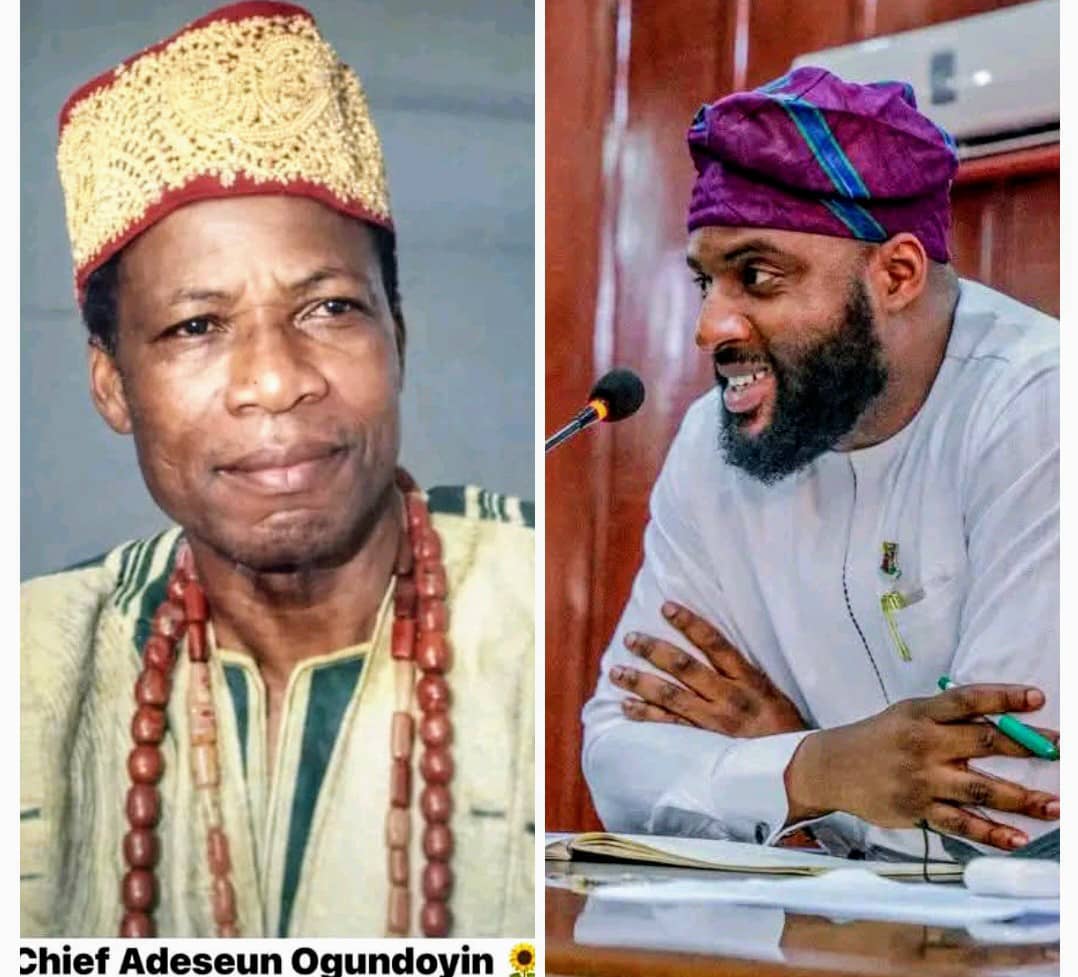
In Ibarapaland, people do not just rush to sing praises. They watch keenly and they compare antecedents because they remember everything no matter the tiny fragment of information.
With the bold legislative reforms at both state and national levels being championed by a son suffice to say is a replica of his father, the people of Ibarapaland remember Late Chief Adeseun Ogundoyin.
Long before politics entered the picture, his name meant industry, generosity and strong presence. He was an Eruwa born business mogul whose influence stretched far beyond the town’s dusty roads and across the length and breadth of Oyo state.
Yet for all his global reach, it was home that felt his impact most. When he died in 1991 at 61, he left behind more than wealth. He left behind stories. Of scholarships quietly paid. Of interventions made without cameras or the glare of press men. Of a man who believed success meant lifting others.
Late Chief Adeseun Ogundoyin was many things at once. A business tycoon with global reach. A philanthropist whose generosity cut across class and politics. A fearless political actor during the SDP and NRC era who challenged established structures when others chose comfort.
But beyond titles and influence, what people remember most is impact.
Long before corporate social responsibility became fashionable language, he was already investing heavily in education and community development.
His most enduring gift remains what is today known as Adeseun Ogundoyin Polytechnic, Eruwa. Bringing a tertiary institution to rural Ibarapaland was not a small gesture at the time. It was transformative.
It meant young people no longer had to migrate to big cities before dreaming of higher education. It meant local businesses grew around a campus. It meant knowledge found a home outside urban centres.
When he passed away on June 18, 1991 at 61, the loss was deeply felt. Years later, during the Oyo State at 50 Golden Jubilee celebrations, he was posthumously honoured with an Oyo Merit Award. For many, it simply formalised what they already believed. His contributions had reshaped lives.
But legacy does not end at remembrance. It moves. It evolves. Today, that movement is visible in his son, Adebo Ogundoyin.
Decades later, that memory still lingers in conversations across Eruwa, the capital of Ibarapa East Local Government.
Today, his son, Adebo Ogundoyin, is already walking similar path, one shaped by the same expectation.
As Speaker of the Oyo State House of Assembly, he occupies a powerful office, the number three seat in the state. Yet in many ways, his political story begins at home.
At his father’s 28th memorial anniversary in Eruwa, he spoke with disarming simplicity. He said his father’s commitment to humanity pushed him into politics.
He described politics as the widest platform to touch lives. It did not sound rehearsed. It sounded personal.
He admitted that his constituency embraced him partly because of the goodwill his father built.
That acceptance, he suggested, is not something to take lightly. It is something to repay.
He spoke of his mother, Chief Mrs. Tina Ogundoyin, who continued philanthropic efforts until she also passed away. He mentioned starting his own foundation before holding public office.
Now, with the machinery of government behind him, he says he can do more.
There is something vulnerable about acknowledging that your rise is tied to a legacy. It means you cannot afford to underperform.
Across Eruwa, Lanlate, Igboora, Idere, Ayete, Tapa and Igangan, electricity has been erratic for more than fifteen years. In some areas, it is practically absent.
Small business owners plan their day around fuel availability. Welders pause mid job when generators sputter. Students read with rechargeable lamps that barely last the night.
It is easy for prolonged hardship to become background noise. People adjust. They complain less loudly.
Recently, during plenary, the Speaker chose not to let it remain background noise. He called attention to the crisis, pointing out that electricity regulation falls largely under federal responsibility, particularly the Federal Ministry of Power and associated agencies.
He spoke of broken transformers, weak feeders and substations promised but not completed. He referenced the continued estimated billing by the Ibadan Electricity Distribution Company, even in communities that barely receive supply.
But beyond the technicalities was something more human. A recognition that darkness affects dignity.
When power fails consistently, businesses shrink. Young people migrate. Institutions struggle. Even hope dims a little.
The House resolved to push for faster federal intervention and infrastructure upgrades. It mandated its Committee on Energy to follow up and report back within weeks.
For residents, the motion was not just paperwork. It was acknowledgment. Someone had said, on record, that this is not normal.
If the electricity debate addressed systemic neglect, the new and first ever secondary school recently commissioned in Temidire already addressed something bigger than distribution of cash gifts or food items to impress.
Temidire is not loud. It is one of many small communities folded into Ibarapa East. For years, children there finished primary school with excitement that slowly turned into worry and dimmed hope.
There was no secondary school nearby.
To continue their education, they travelled about 30 minutes by motorcycle to Eruwa. Some crossed into Ogun State. Mornings began with waiting at junctions for vehicles.
Sometimes they arrived late and missed key subjects. Sometimes they returned home at dusk, tired and discouraged.
Over time, some simply stopped going.
Parents worried about safety. Teachers worried about dropout rates. Community leaders wrote letters that seemed to disappear into bureaucracy for about two decades under successive administrations.
Then, on his 39th birthday, the Speaker stood in Temidire and commissioned a fully furnished secondary school. Two classroom blocks. Offices. Toilets with running water. A motorised borehole. Desks neatly arranged. Books and school bags distributed.
Academic activities are already scheduled to begin in September 2026.
It was not a grand metropolitan project. It was something more intimate. A school close enough for children to walk to.
When education is within reach, attendance improves. Girls are less exposed to roadside risks. Parents breathe easier. Dreams feel practical instead of distant.
Residents described the school as a lifetime legacy. Not because it bears a political signature, but because it changes a daily reality.
Being the son of a widely respected philanthropist in a close knit region is not entirely comfortable. Every action invites comparison. Every shortfall risks being amplified.
Late Chief Adeseun Ogundoyin built his reputation in private enterprise and personal generosity. His son operates in the public arena, under scrutiny, navigating legislation, party politics and institutional constraints.
Representing Governor Seyi Makinde at the school commissioning, the state government reaffirmed its broader commitment to education reforms, from teacher recruitment to digital learning initiatives.
The Temidire project fits into that ecosystem, but it also carries a more personal undertone. It feels like continuity.
Across Ibarapa East, other projects tell the same story. A primary health centre at Lagaye. Boreholes in rural communities. Youth empowerment initiatives. Another secondary school nearing completion in Ojonamo.
Individually, they are development projects. Collectively, they are reassurance that representation can be tangible.
The father demonstrated that prosperity should circulate. The son appears determined to show that power should serve.
In homes once lit by kerosene lamps, people now wait for substations to come alive. In Temidire, children who once hesitated at crossroads will soon walk into classrooms built for them.
Like father, like son is an easy phrase. But in Ibarapa, it carries expectation. It demands consistency.
For now, many residents see in the Speaker’s youthful energy not just ambition, but continuity and consistency in sustaining family legacy of unflinching commitment to public service. A translation of inherited values into modern governance.
And in communities that remember deeply, that very continuity may just be the strongest foundation of all.