

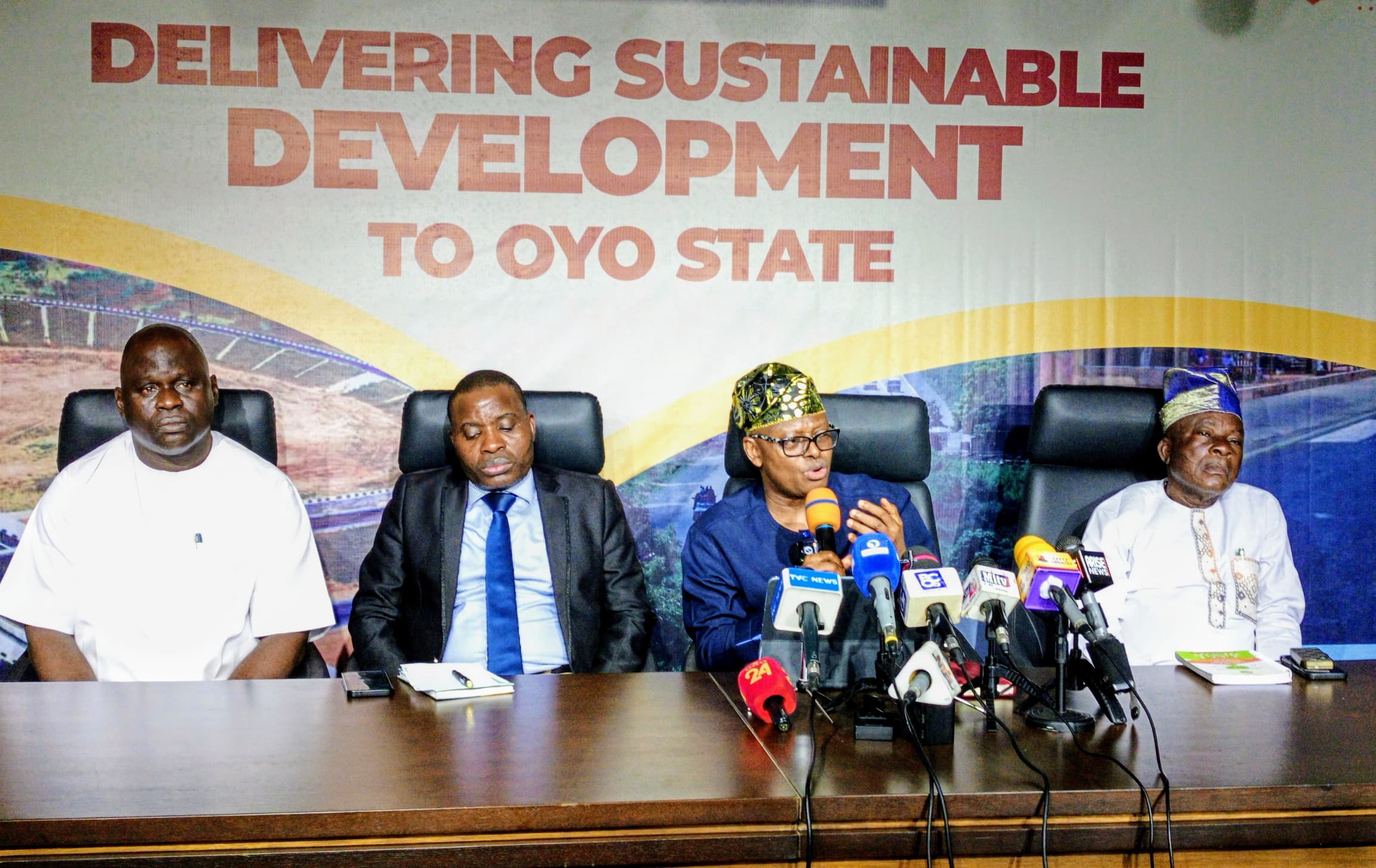
The Oyo State Government has unveiled an a roadmap to transform its electricity sector while projecting an increase in power supply to about 300 megawatts by 2027 as part of efforts to stimulate economic growth and improve service delivery across the state.
The Commissioner for Energy and Natural Resources, Professor Dawud Sangodoyin, who doubles as the acting chairman of Oyo State Electricity Regulatory Commission, disclosed this during a press conference on the ’s power sector reform, held on Wednesday, April 1, at the Press Conference Room of the Governor’s Office, Ibadan.
Sangodoyin stated that the state currently generates between 151 and 182 megawatts of electricity, which he said is far below the estimated minimum requirement of 520 megawatts needed to support a modern and productive economy.
“Our findings show clearly that the minimum electricity requirement for a state like ours is about 520 megawatts. What we have at the moment fluctuates between 151 and 182 megawatts, and even that is not stable. That means we are operating at less than 25 percent of what is required,” Sangodoyin said.
To bridge this gap, the state has commenced immediate interventions, including the development of a 12 megawatt independent gas-powered project expected to come on stream within the next two months. According to the commissioner, this will raise available capacity to about 194 megawatts in the short term.
“That is just the beginning, the plan is to add another 120 megawatts between the second quarter of this year and the second quarter of 2027. By doing so, we aim to reach close to 300 megawatts, which will significantly improve our economic outlook.”
As part of efforts to secure sustainable energy sources, the state government has entered into a Memorandum of Understanding with Shell to support gas distribution infrastructure.
He explained that the partnership is expected to enhance the supply chain once regulatory engagements with federal gas authorities are concluded.
In his words: “Shell is supporting us with gas distribution from our gateway, once we resolve ongoing discussions with the relevant national authorities, that will take a major burden off our supply constraints.”
Sangodoyin said that the government is also opening up the electricity market to private sector participation, with plans to approve multiple power providers across generation, transmission and distribution saying “one investor has already indicated interest in hydroelectric power generation”.
“We are creating a structure where investors can come in, access our electricity priority plan, conduct feasibility studies and deploy solutions. We have segmented the state into industrial, institutional, residential and underserved clusters to guide targeted investments,” Ogundoyin stated.
On regulation, Sangodoyin emphasized that the Oyo State Electricity Commission now serves as the primary authority overseeing electricity activities within the state, in line with existing laws.
“There is now a local regulator empowered to license operators and address issues around supply, tariffs and service delivery, anyone operating in the electricity space within the state must obtain the appropriate license from the commission before operation,” he added
Speaking further, Sangodoyin added that the commission has also established a responsive complaint system for residents and businesses saying “our website is live, and we have committed to responding to complaints within 72 hours. This is about bringing governance closer to the people.”
Highlighting ongoing infrastructure upgrades, the Sangodoyin revealed that the independent power project will initially serve critical public institutions in Ibadan, including the State Secretariat, Government House, courts and surrounding street lighting networks.
“This project will power key government infrastructure and improve efficiency. We will also carry out an energy audit to allow nearby communities to benefit from the system.”
In addition, he said the government has begun transitioning parts of its street lighting network to solar energy, with pilot schemes already completed in select areas.
“We have tested solar-powered street lighting in some locations, and the results are encouraging. The plan is to scale this across the state,” he added.
Speaking on the broader economic implications of improved electricity supply, the Commissioner noted that stable power would reduce business costs, increase productivity and create jobs.
Sangodoyin said: “I have personally seen artisans working late into the night because that is when power is available. If we can provide stable electricity during the day, their productivity will increase, and that will have a ripple effect on the economy.”
On investor confidence, he disclosed that the state has reached out to over 30 potential investors, assuring them of a transparent and stable regulatory environment. “With clear regulations, consistency in policy and protection for investments, we are creating an enabling environment,” investors will bring capital and innovation, while we provide the framework.”
Addressing concerns about alignment with federal authorities, the commissioner maintained that the state’s actions are consistent with national legislation, including the Electricity Act and the Petroleum Industry Act.
He said: “We are not acting in isolation, our approach is aligned with federal laws, and we are engaging relevant institutions to ensure a win-win outcome.”
He further stressed the importance of competition in the electricity market, warning against monopolistic structures.
“If only one entity controls the market, we risk repeating past challenges but with multiple players, service delivery will improve and tariffs will become more competitive,” Sangodoyin noted.
Despite acknowledging transitional challenges, particularly with existing distribution companies, he expressed confidence in the reform process, assuring that the state will soon start to enjoy improved power supply.
He said: “Every reform comes with its own challenges, especially during transition but we are engaging all stakeholders to ensure that the people of Oyo State ultimately benefit.”
He reaffirmed the government’s commitment to building a reliable, affordable and sustainable energy system capable of transforming the state’s economic fortunes.
“Our objective is clear, we want to deliver electricity that supports businesses, improves livelihoods and positions Oyo State as a leader in subnational power sector development in Nigeria,” he concluded