

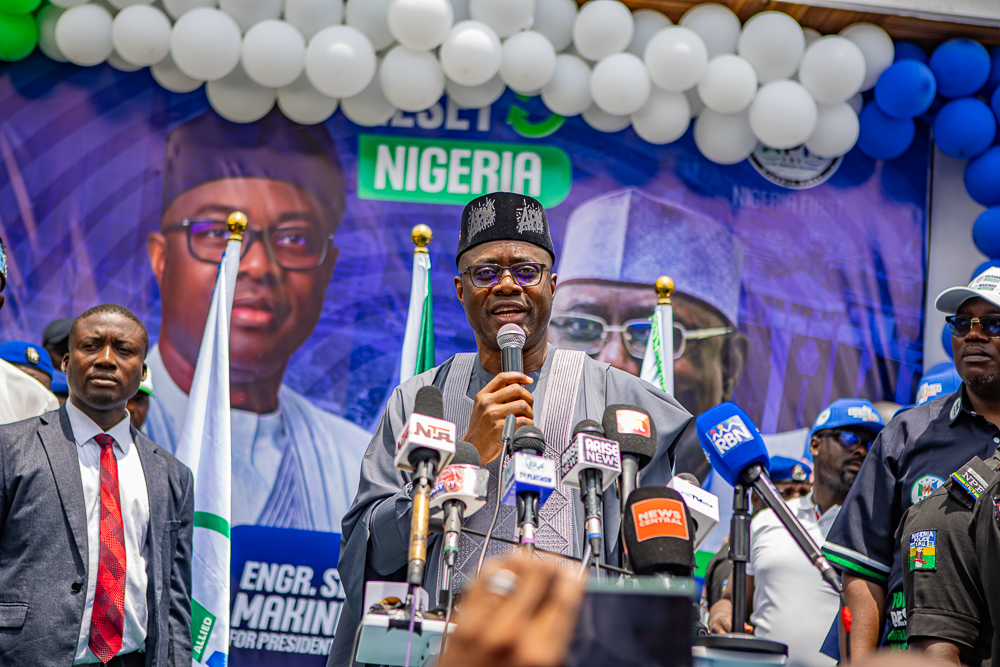
The Special Adviser to the Oyo State Governor on Media, Dr Sulaimon Olanrewaju, has described as “grossly incompetent” the attempt by the campaign organisation of the All Progressives Congress (APC) governorship candidate in Oyo State, Senator Sharafadeen Alli, to blame Governor Seyi Makinde for the economic hardship confronting Nigerians.
Olanrewaju, in a statement on Thursday, October 1, 2026, said the statement by the Sharafadeen Alli Campaign Organisation demonstrated a failure to understand the relationship between national macroeconomic policies and the economic realities being experienced across the country.
He said at a time Nigerians were grappling with severe economic hardship, it was irresponsible for the APC campaign organisation to “replace facts with theatrics” by attempting to personalise or localise challenges that, according to him, were largely the consequences of national economic policy decisions.
According to him, Nigeria’s current economic situation “is not the result of state-level governance failures,” but is linked to national policy choices that have significantly altered the fiscal and economic environment across the federation.
Olanrewaju cited the depreciation of the naira following the currency reforms, saying the currency, which traded around ₦450–₦470 to the dollar at the official window in 2023, now fluctuates within the ₦1,400–₦1,600 range.
He argued that the depreciation had contributed to increased costs of food, medicine, transportation and production inputs nationwide, adding that no state governor could completely insulate residents from inflationary pressures generated by such a significant currency movement.
The governor’s aide also linked the removal of petrol subsidy in 2023 to increased transportation and food costs, as well as rising inflation and high cost of living.
He said poverty had also deepened amid the economic difficulties, arguing that the situation should be understood as a national economic challenge rather than a failure attributable to an individual state.
Olanrewaju criticised Alli for allegedly reducing complex economic realities to political blame-shifting, saying the Oyo APC governorship candidate’s attempt to hold Makinde responsible for nationwide economic shocks was “uninformed and disingenuous.”
He also challenged the campaign organisation’s reference to increased allocations from the Federation Account Allocation Committee (FAAC), arguing that higher nominal allocations to states did not necessarily translate into increased purchasing power.
According to him, increased FAAC revenues could occur alongside higher oil prices, reduced subsidy deductions and naira depreciation, while inflation simultaneously eroded the real value of the funds available to governments.
“A ₦10 billion allocation today cannot deliver the same value as ₦10 billion in 2022. Higher nominal revenue in an inflationary environment is not prosperity; it is erosion,” he said.
The governor’s aide said this was what Governor Makinde meant by his description of the situation as a “Voodoo Economy.”
Olanrewaju further dismissed the allegation that Makinde was “criminally” opposed to local government autonomy, describing the issue as a constitutional matter that remained subject to legal and institutional processes.
He argued that although the Federal Government had secured a Supreme Court judgment concerning local government financial autonomy, the implementation of the judgment remained a matter involving the Federal Government and the constitutional framework governing the State Joint Local Government Account.
“How Senator Alli, a lawyer, does not understand that with the State Joint Local Government Account Allocation Committee still embedded in the constitution, ‘local government autonomy’ remains a misnomer is beyond me,” he said.
Olanrewaju maintained that Nigeria was experiencing a difficult economic period, with currency depreciation, inflation, petrol subsidy removal and rising poverty affecting citizens across the country.
He said state governments, regardless of political affiliation, could not completely reverse nationwide macroeconomic shocks through state-level expenditure alone.
He consequently urged political actors to engage the public on the facts and policy choices responsible for the country’s economic situation rather than attributing national economic challenges to individual state governors.