

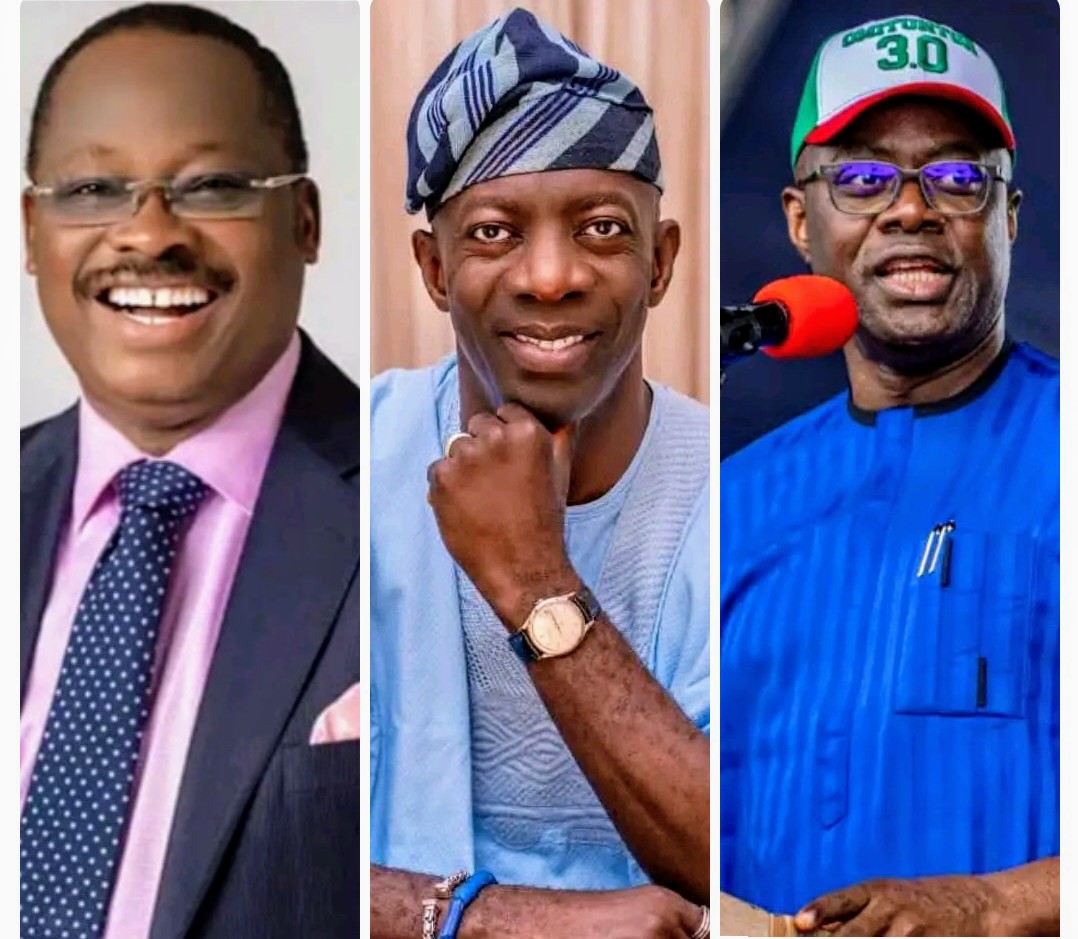
The evolution of politics world over has given it an outlook that often resembles a crowded marketplace where the loudest voices compete for attention, yet, history also repeatedly reminds us that some of the most enduring leaders are not those who shout above the crowd, but those who quietly build bridges while others are busy erecting billboards along every major road.
One individual who has continued to emerge from the tapestry of Oyo state’s political conversations like a carefully woven thread whose significance becomes clearer with every passing day is Bimbo Adekanbi, the governorship candidate of the Allied Peoples Movement (APM).
A man many political stakeholders include partisan and non partisan, especially his supporters, have described as a ‘calm hand on the wheel in turbulent times’.
Unlike politicians whose careers are forged in the furnace of endless political combat, Adekanbi’s public journey resembles that of a craftsman who spent years mastering his tools under two different unrivalled masters before stepping onto the grand stage.
His story is not one of sudden political fireworks; it is the story of a lantern that has steadily gathered brightness through years of public service, administrative experience and economic stewardship.
The story of how Bimbo Adekanbi found his way into the political orbit of Governor Seyi Makinde is one that many have described as a triumph of competence over partisanship.
For years, Adekanbi was identified with the political family of the late Abiola Ajimobi. He served as Deputy Chief of Staff and later Commissioner for Finance under Ajimobi’s administration, becoming one of the key faces of the APC government between 2011 and 2019. When Ajimobi left office, many assumed Adekanbi’s public service journey would remain permanently tied to the opposition camp.
But politics, however, often creates unlikely bridges. When Seyi Makinde assumed office in 2019, Oyo State was sharply divided along party lines. Yet beneath the noise of partisan competition, there was a growing recognition of Adekanbi’s reputation as a financial expert and administrator.
Even political opponents acknowledged his professional competence and understanding of public finance. Over time, Makinde appeared to look beyond party labels and focus instead on experience, technical capacity, and the ability to deliver results.
The defining moment came in 2024 when Makinde appointed Adekanbi to chair the committee overseeing the upgrade of the state’s airport project, a strategic assignment that attracted significant public attention.
For many political analysts across the state and beyond, the appointment was remarkable. Here was a governor entrusting a major state project to a man who had served prominently in an opposition administration. The decision immediately fuelled conversations across the state about the level of confidence Makinde had in Adekanbi’s abilities.
The appointment was more than a routine government assignment in the eyes of many within the political circle. It was a signal. Makinde appeared to be saying that competence should not be imprisoned by political boundaries.
Rather than viewing Adekanbi as a former APC commissioner, he viewed him as a professional with valuable experience to contribute to the state’s development.
As their working relationship deepened, political speculation intensified. Adekanbi gradually became a familiar figure within Makinde’s wider political consultations and transition discussions.
He participated in engagements with political stakeholders and advisory bodies established to discuss the future leadership of Oyo State. What initially appeared to be a professional collaboration gradually evolved into a new political family.
By 2026, the relationship had reached a historic point. Makinde openly endorsed Adekanbi as his preferred successor for the governorship race, despite Adekanbi’s roots in the Ajimobi administration and opposition politics.
Explaining his choice, Makinde reportedly emphasized administrative capacity, experience, and the need for continuity of governance rather than strict partisan considerations. The governor acknowledged that some questioned why he chose a man who had once belonged to a rival political camp, but he maintained that leadership should be determined by merit and preparedness.
Seen through a human lens, the story is one of two leaders from different political traditions finding common ground in governance. Just as Ajimobi once looked beyond Adekanbi’s career in the private sector and persuaded him to enter public service, Makinde looked beyond party affiliations and saw a technocrat whose experience could be useful to the state.
One governor discovered him in the boardrooms of London; another rediscovered him in the arena of governance.
The result is a political journey that few could have predicted; a man recruited into public service by Ajimobi, later embraced by Makinde, and eventually positioned as a figure capable of bridging two major political traditions in Oyo State. Whether viewed politically or historically, it remains one of the most intriguing stories in the state’s contemporary leadership evolution.
Today, as Oyo State searches for the custodian of its next chapter, many eyes are turning toward the former Commissioner for Finance, not merely because of the office he once occupied, but because of the footprints he left behind.
Before politics embraced him, Adekanbi was already fluent in the language of numbers.
He belonged to that rare class of public servants who understand that behind every budget figure lies a human story.
Every allocation represents a classroom waiting to be built, a road yearning for asphalt, a hospital seeking equipment and a family hoping for quality standard of living and a better tomorrow.
During the administration of the late Senator Abiola Ajimobi, the man who first discovered Adekanbi’s rare talent, the then political disciple had served as Commissioner for Finance, occupying a position that can best be described as the engine room of governance.
While governors often stand on the bridge of the ship, finance commissioners work below deck, ensuring the vessel remains afloat through storms and calm waters alike.
At a period or national dispensation when many states across Nigeria struggled under the weight of economic uncertainty, Adekanbi became one of the principal navigators of Oyo’s fiscal compass.
He was among those entrusted with ensuring that government ambitions did not outrun available resources.
Political supporters, even across party lines, have argued that his years in that position gave him something more valuable than political popularity, and that is a deep, intimate understanding of how government truly works.
He learned under Ajimobi where the gears of governance grind, where resources leak out into wrong hands and where opportunities hide.
That experience, they believe, has prepared him not merely to occupy power but to understand its machinery.
Every leader is no doubt shaped by a political classroom. That’s why for Adekanbi, that classroom was the administration of the late Governor Abiola Ajimobi, one of the most influential political figures in modern Oyo history.
Whether praised or criticised, Ajimobi altered the landscape of governance in Oyo State in ways that have continued to shape public discourse today.
As one of the trusted members of that administration, Adekanbi sat close enough to witness how difficult decisions were made and how leadership requires balancing vision with reality.
He actually had a seat at the table and watched governance from the front row under during the Ajimobi era.
He saw that leadership is neither poetry nor magic. It is a daily struggle between competing demands, limited resources and public expectations. Those lessons have also become the chisels that gradually carved his administrative philosophy.
In politics, many leaders sometimes become prisoners of their camps, that is why Adekanbi’s story resembles a bridge stretching across rivers that once appeared impossible to cross.
Having served under Ajimobi and later finding political grooming and alignment within the orbit of Governor Seyi Makinde’s political movement, he no doubt, occupies a unique space in Oyo’s current political architecture.
His journey illustrates a truth often forgotten in Nigerian politics, and that truth is the fact that development does not recognise party colours.
Roads do not ask who built them, schools do not discriminate between political affiliations, and hospitals do not treat patients according to party membership cards.
This ability to attract goodwill across political boundaries has become one of Adekanbi’s strongest political assets.
To supporters, he represents continuity without rigidity and change without instability.
At every twilight stage in the lifespan of every administration, the leader or outgoing government is often confronted by a defining question: who carries the torch when we steps aside?
That question now clearly hovers over Oyo State like a cloud pregnant with anticipation by a people envisaging if it would rain or not.
Governor Seyi Makinde’s administration has delivered projects and policies that have transformed conversations about governance in the state.
Naturally, many citizens wonder who possesses the leadership quality, temperament and competence required to sustain the momentum without excuses for failure.
If anything, Makinde has shown clearly that where there is a will, there is always a way out of every challenges. He proved it during the COVID-19 era, he did it again when the subsidy regime ended and Nigeria’s foreign exchange floated thereby crumbling the nation’s economy and instantly imposed economic hardship nationwide.
For a growing number of stakeholders, Adekanbi appears increasingly suited for that same role and responsibility because of the two political schools of thought that forged him into who he has become.
They see in him a man whose strengths align with the demands of modern governance and within the age bracket that resonates with modern reality.
A man who understands economics and its management.
A man who understands administration.
A man who understands that development is a marathon rather than a sprint.
To them, his candidacy is not simply about winning an election; it is about sustaining and preserving a trajectory already laid out by the Makinde’s administration.
Political parties are often compared to vehicles, but the true measure of a journey lies not in the vehicle itself but in the driver behind the wheel. This is what gave birth to the popular “oto ni eyan, oto ni egbe” expression within political circles.
The APM platform has provided Adekanbi with a political vessel through which he can articulate his vision for Oyo State.
His emergence as the party’s governorship candidate has transformed what some initially dismissed as a minor political development into a significant force within the state’s political equation.
Supporters view the APM as a fresh pathway through which old divisions can be replaced with a coalitions of progress of genuinely forward-looking leaders resdy and willing to take Oyo state to its next level development.
They see the party not as a destination but as a bridge leading toward a larger developmental vision.
It’s important to note that modern governance has increasingly taken a resemblance with an outlook of a complicated machine.
It requires leaders capable of understanding economics, infrastructure, technology, education, healthcare and investment, not those who are lost in thoughts and buried in the status quo of the old order where protecting the interest of the elites as against the masses is equals to good governance.
The era when charisma alone or even belonging to the party at the top could sustain government performance is rapidly fading.
Today’s realities demand competence, preparation, and expertise. At least, to a larger extent. This is one of the reasons technocrats in politics are gradually gaining prominence because they understand how to build bridges that connects the old and new order in government.
This is exactly where Adekanbi’s greatest appeal lies because of his background in the organized corporate world in the diaspora and later transitioned into public life serving as the financial manager of the state under Ajimobi as well as Chairman of Ibadan Airport upgrade committee under governor Makinde.
Adekanbi is often portrayed as a technician rather than a showman, a builder rather than a performer.
Like a seasoned engineer examining a complex structure, he approaches governance through planning, analysis and execution using the same decision making method as governor Makinde; science (evidence based), logic (reasonable), and data (facts).
Adekanbi’s supporters across the state believe these qualities make him particularly suited to lead a state that is expanding economically and demographically.
Like the strongest trees that spend years developing roots before their branches touch the sky, Adekanbi’s political journey has been characterized by vast on the job experience that could best be described as “an economic era of the good, the bad, and the ugly”, yet, still being celebrated as a prudent and efficient manager of human and material resources.
In many respects, Adekanbi’s journey mirrors that natural process. His years in public service, his experience in managing state finances and his growing political influence have steadily prepared him for a greater role.
The road to Agodi Government House remains long, and elections are ultimately decided by the people.
Yet, as Oyo’s political clock ticks steadily toward 2027, Adekanbi’s name continues to pierce through town halls, political meetings and public discussions, even across political divide.
Considering the array of contenders for the number one office in Oyo state on various political platforms, their track records in public life in terms of impacts on the people not personal status that granted access to overnight wealth, it is safe to say that Adekanbi remains the candidate to beat come 2027.
Ibrahim Adekola writes from Yemetu, Ibadan.