

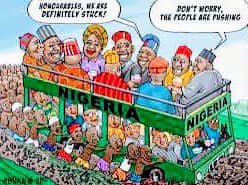
Walk into any beer parlor, eatery, church, mosque courtyard, or motor park in Nigeria during election season and you’ll hear these words: “Our people must not lose this time.” Rarely do you hear, “Which candidate has the best plan for jobs, power, or schools?”
This is the heart of Nigeria’s political tragedy where identity trumps competence. Ordinary poor people quarrel themselves bitterly over tribe and religion, yet the same politicians who ignite these quarrels easily cross ethnic and religious lines once the election is over. They trade positions, share contracts, and attend each other’s family events.
It’s what I call “friends at war, enemies at peace.” While the grassroots ‘gullibly’ not ignorantly, fight proxy battles, the elite break bread together.
This edition of Editor’s Diary takes a cursory look at how we got here, how Oyo State mirrors the larger Nigerian problem, how the poor are trapped as pawns in the game.
This article also traces how ethnocentrism and religious signaling became hardwired into Nigerian politics and how the poor have been used as pawns on an elite chessboard—along with what it would take to break the cycle.
First, let’s understand the roots of identity politics. The British perfected divide-and-rule. They used “native authorities,” chieftaincy councils, and census figures to pit groups against one another. Access to schools, jobs, and scholarships depended on where you came from. Identity became a currency.
Then politics was split into regions that neatly aligned with ethnicity; Hausa/Fulani North, the middle belt at the center, Igbo East, Yoruba West. Parties became ethnic banners. Violence and coups were justified as protecting “our people” from domination.
The 1967–1970 war left deep scars. Oil wealth turned politics into a contest for who controlled Abuja’s purse. Federal character, quotas, and state creation were meant to balance things but unfortunately, instead entrenched identity bargaining.
With democracy came open competition, but also zoning and religious balancing. Power rotates; tickets are crafted with one Christian and one Muslim. This has stabilized politics, yes, but it has also on the other hand cemented identity as the master key to power.
Let’s unpack how ethnoreligious politics works today in Nigeria across all the 36 states including the Federal Capital Territory.
Zoning as both ladder and ceiling gives some regions access, but it also reduces leadership contests to “whose turn” rather than “who is competent.”
Politicians visit mosques on Friday, churches on Sunday, sponsor pilgrimages, and hand out rice during festive seasons. With these gestures, symbolism now matters more than substance. Jobs, contracts, and welfare also pass through ethnic and religious brokers. The poor defend “their own,” not because of results, but for crumbs.
And when it’s election time, politicians mobilize “boys” along identity lines. The entire process of elections now become mini-referendums of “us vs. them” a a great recipe for retrogressive approach to forward looking democracy in any society or saner clime, yet Nigerians hope things would get better with time without the right attitude towards politics and governance.
This mindset of holding on to everything that is wrong in approach to politics and governance can best be described as a people waiting at a motor park and hoping an aeroplane would come and pick them to their destination. No! Things don’t work that way.
The people who genuinely desire to fly must leave the motor park and move to the tarmac, that’s the only location for aircrafts.
This means that, to live in self imposed delusion or denial of obvious reality is a choice not an accident, that is why as much as the bad leadership, the people are also culpable of whatever happens to them in a bad system.
Look closely, politicians who campaign with tribal and religious rhetoric later strike alliances across those same divides. They defect, form unity governments, or attend each other’s coronations, turbanings, and thanksgiving services.
Meanwhile, ordinary citizens, the conductors, farmers, market women are left fighting bitterly over who belongs and who doesn’t. The people most divided are the ones with the least to gain.
Oyo state for instance, offers a fascinating case study. It’s mostly Yoruba, yet identity politics thrives here in subtler forms:
First, intra-yoruba zoning: Ibadan, Ogbomoso, Oke-Ogun, Oyo, and Ibarapa all want their “turn.” Elections become referendums on geography, not governance.
Secondly, religion comes handy as a campaign strategy. Candidates mix Christian–Muslim tickets, attend interfaith events, and use pastors and imams as mobilizers, yet, the ordinary poor people seeing the truth still choose to believe the lies inherent. Traditional institutions and other chieftaincies are also drawn into political battles for endorsement value.
Geopolitical zones such as Oke-Ogun and Ibarapa communities complain endlessly of neglect despite their agricultural importance socioeconomic might as sources of raw materials yet, power shifts rarely change the neglect.
The truth is simple and unambiguous; when roads, hospitals, and schools work, identity politics cools down. Where government fails, identity becomes the loudest campaign slogan.
To fully understand how the poor masses are used as political tools with their consent, certain concepts.
First is emotional blackmail. Politicians tell the voters “Your faith is under attack.” “They will dominate us.” Fear turns citizens into unpaid campaigners. Of a truth, there may be semblances of truth in this belief but how these same politicians dine and wine together after elections are over leaves many unanswered questions in the mind.
Poverty as a political weapon in the hands of the politicians. Tokens are dolled out instead of transformation. Bags of rice, ₦5,000 handouts, branded T-shirts, crumbs are in exchange for loyalty and support. When violence breaks out, the poor are arrested while the real sponsors resurface at the next coalition meeting.
The Editor’s Diary also delved into trying to understand why Nigerians avoid the real conversation in selecting leaders at various levels based on competence against some of these rigid rhetoric.
When zoning feels like insurance cover, to question it is to risk exclusion and this implicates everyone; the clerics, chiefs, party leaders, even journalists benefit from identity brokerage.
If Nigerians drop identity as the measure, governance must be judged by roads fixed, academic success rates at all levels of learning, security of lives and property, quality of life of the people, and maternal mortality. That exposes failure.
Healthier politics should political parties publish time-bound deliverables in form of blueprints and manifesto so that they can be examined, evaluated, and judged by them.
Campaign finance transparency, interfaith peace pacts, community policing are all factors that can reduce election risks. Nigerians must therefore, vote for results, not root.
Nigeria’s ethnoreligious politics survives because it works for the elite. The same leaders who urge you to “defend your tribe or faith” share the spoils with supposed enemies behind closed doors.
Oyo State proves that identity isn’t just North vs. South or Christian vs. Muslim; it can even be Ibadan vs. Ogbomoso, or Oke-Ogun vs. Ibarapa. Left unchecked, it fragments endlessly while poverty deepens.
Identity is human and sometimes necessary. But it must not define everything. If citizens demand measurable service, transparent budgets, and real timelines, politicians will be forced to compete on delivery, not division.
Only then will the pawns step off the chessboard and finally become players.
We cannot wish identity away; it is human and, in a diverse federation, sometimes necessary for fairness. But it must be a consideration, not the constitution of our politics.
Friends can remain friends and enemies can remain enemies but only at the ballot box of performance. When results, not religion or region, decide elections, the pawns finally step off the board and become real players as political stakeholders.
Editor’s Dairy is a weekly column on westernmirror.com.ng designed for socio-economic and political analysis.