

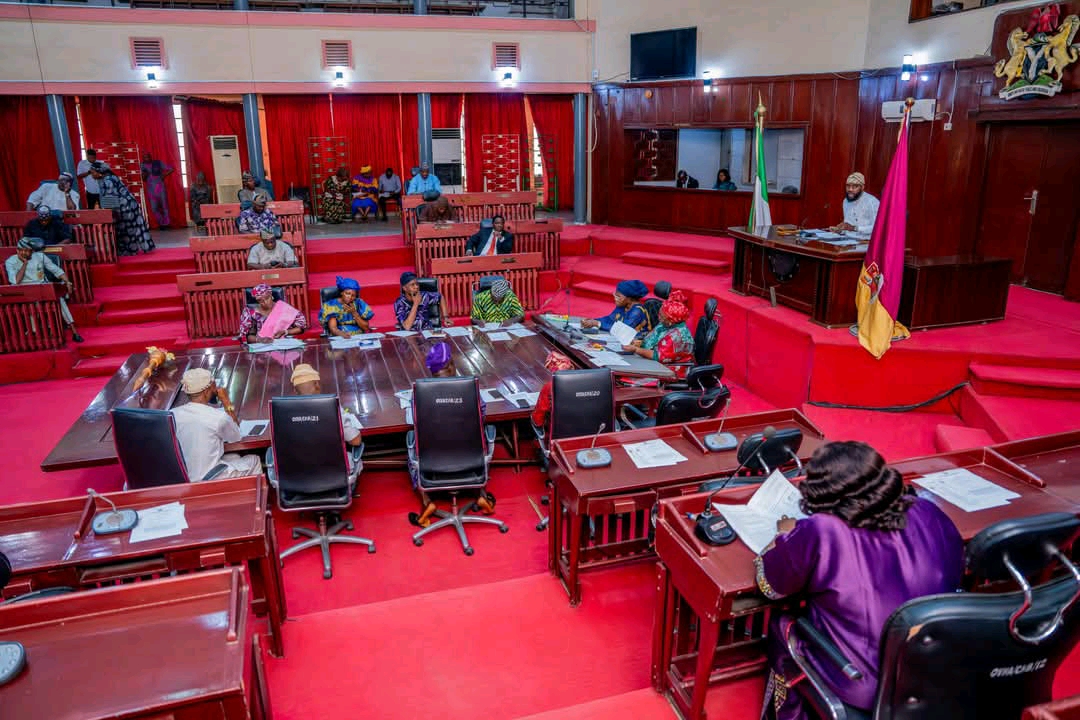
The proposed constitutional amendment providing for the establishment of State Police Services has been transmitted to the Oyo State House of Assembly for legislative consideration and approval as lawmakers prepare to resume plenary.
The bill, transmitted to the Assembly by the Clerk to the National Assembly seeks to amend the 1999 Constitution to create a constitutional framework for the establishment of State Police Services while retaining the Nigeria Police Force as the federal police service.
The transmission followed the passage of the Executive Bill by the Senate on June 24, 2026, and the House of Representatives on July 23, 2026.
The letter, addressed to the Speaker of the Oyo State House of Assembly, stated that the transmission was made pursuant to Section 9(1) and (2) of the Constitution of the Federal Republic of Nigeria, 1999, as amended.
The provision requires constitutional alteration bills to secure the required legislative approvals at both the federal and state levels.
According to the bill’s explanatory memorandum, the proposed amendment would establish a constitutional pathway for states wishing to establish their own police services, subject to the Constitution and an Act of the National Assembly prescribing national minimum policing standards.
The proposed framework, however, does not abolish or replace the Nigeria Police Force.
Rather, the bill provides that the Federal Police Service would remain the default police service in any state until a State Police Service is lawfully established and certified operational.
It also expressly preserves the continuing federal policing role in every state and the Federal Capital Territory, Abuja.
The bill proposes constitutional safeguards covering civilian control, human rights, national minimum policing standards, independent police service commissions and intergovernmental cooperation.
It also provides for criminal information systems, firearms control and circumstances under which the federal authorities could intervene in state policing.
Such intervention, according to the explanatory memorandum, would be applicable in cases involving a breakdown, serious incapacity, national security threat or egregious abuse.
The proposed amendment leaves detailed issues relating to the organisation and procedures of State Police Services, operational control, certification, complaints mechanisms, grants and implementation arrangements to subsequent legislation by the National Assembly and, where applicable, laws enacted by the various State Houses of Assembly.
The arrival of the bill places the Oyo State House of Assembly among the state legislatures expected to consider the proposed constitutional alteration as part of the process for its eventual enactment.
The transmission letter, which was signed on behalf of the Clerk to the National Assembly, specifically requested the Oyo Assembly to consider and approve the bill.
The development comes as the state legislature prepares to resume plenary, with the State Police proposal expected to form part of the constitutional and legislative issues requiring consideration by the lawmakers.
If approved by the required number of State Houses of Assembly and upon completion of the constitutional amendment process, the proposal would provide a legal framework through which individual states could establish and operate their own police services under nationally prescribed minimum standards.